By World Media Feed Editorial Team
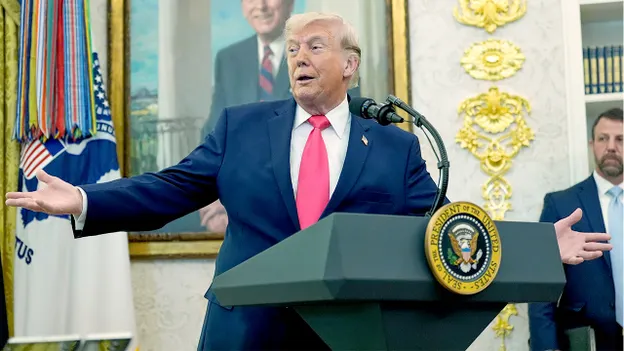
WASHINGTON, November 9, 2026 — U.S. President Donald Trump said Monday that he would refrain from launching new military strikes against Iran for the time being, following appeals from regional leaders seeking to prevent another escalation in the conflict.
The announcement followed a meeting at the White House with Qatari Prime Minister Sheikh Mohammed bin Abdulrahman Al-Thani, whose government has played a central role in diplomatic efforts between Washington and Tehran.
Despite the temporary restraint, Trump made clear that the United States would maintain its naval blockade targeting Iranian ports and remain prepared to resume military action if necessary.
The developments suggest that diplomatic efforts are gaining renewed attention, but the fundamental disagreements between the two countries remain unresolved.
Qatar steps up its diplomatic role
Qatar has emerged as one of the most important intermediaries in efforts to bring the United States and Iran toward an agreement.
The Qatari prime minister met Trump in Washington after visiting Tehran the previous week. His discussions with American officials focused on efforts to end the conflict and identify a possible diplomatic path forward.
Trump said several countries in the region, including Qatar, Saudi Arabia, the United Arab Emirates, Bahrain and Kuwait, preferred a peaceful outcome rather than renewed military operations.
The diplomatic pressure reflects growing concern among Gulf governments that another round of attacks could destabilize the region, threaten energy infrastructure and further disrupt international shipping.
However, regional mediation has yet to produce an agreement that both Washington and Tehran are willing to accept.
The Strait of Hormuz remains a major obstacle
One of the central issues in the negotiations is the Strait of Hormuz, a strategic maritime passage through which a substantial share of the world’s oil shipments normally travels.
The United States continues to enforce a naval blockade against Iranian ports, while Iran has maintained restrictions and threats affecting maritime traffic through the region.
The competing measures have created uncertainty for shipping companies, energy markets and governments dependent on reliable oil supplies.
Iran’s proposal for ending the conflict reportedly includes lifting the American blockade, easing certain sanctions and halting U.S. bombing. In return, Tehran would end its own blockade of the strait, with discussions about its nuclear program and additional sanctions to follow.
Washington has rejected the proposal as insufficient.
U.S. Secretary of State Marco Rubio has publicly described Iran’s conditions as unrealistic, underscoring the distance between the two sides.
Military activity continues despite diplomatic efforts
Trump’s decision to hold off on new strikes does not mean military tensions have ended.
Iranian state media reported explosions on Qeshm Island following overnight strikes. A provincial official said the reported attacks did not damage vital infrastructure or services.
Reuters also reported that a senior Iranian source described the targets as radar systems and military facilities associated with air defense, missile launches and naval operations.
The United States had not publicly confirmed the details of those reported strikes at the time of publication.
Meanwhile, attacks involving commercial vessels in the Gulf and the Strait of Hormuz have continued. Iranian state television has also made claims about tankers being disabled, although those claims have not been independently established.
The continuing military activity illustrates how difficult it may be to maintain a diplomatic process while both sides retain the ability and willingness to use force.
Domestic and regional pressure grows
The conflict is also creating political challenges for the Trump administration.
Republican losses in the recent U.S. midterm elections have intensified scrutiny of the war, particularly its economic consequences and impact on fuel prices.
Senior administration officials have continued to express support for diplomacy, but they have also warned that an agreement is not imminent.
Regional governments face their own concerns. Further escalation could threaten infrastructure, commercial shipping and economic stability across the Gulf.
Turkey has also urged Washington and Tehran to pursue dialogue rather than return to a wider military confrontation.
For countries throughout the region, the immediate priority is preventing the conflict from expanding into a broader crisis.
A pause in strikes is not yet a peace agreement
The latest diplomatic activity offers a possible opening, but the main disagreements remain substantial.
Washington wants an agreement that addresses Iran’s nuclear activities and the security of maritime routes. Tehran is seeking an end to the American blockade, sanctions relief and guarantees against further attacks.
Neither side has publicly accepted the other’s central conditions.
The coming days will show whether Qatar and other regional intermediaries can help narrow those differences.
For now, Trump’s decision to delay additional strikes provides some diplomatic breathing room. But with the naval blockade continuing and military activity still reported, the situation remains fragile.
The challenge is no longer simply preventing the next military escalation. It is finding an agreement capable of ending a conflict that continues to threaten regional security and the global economy.
World Media Feed will continue monitoring diplomatic and military developments across the Middle East.
Sources and reporting references
- Reuters, November 9, 2026 — Reporting on Trump’s decision to hold off on new strikes, the White House meeting with Qatar’s prime minister, Iran’s proposal and continuing regional tensions.
- Associated Press — Background reporting on U.S. military activity, the Strait of Hormuz, diplomatic efforts and the wider consequences of the conflict.
Editorial note: Reports of overnight strikes on Qeshm Island and claims concerning damaged or disabled vessels are attributed to the sources reporting them. They should not be presented as independently verified U.S. military statements.
About the Author