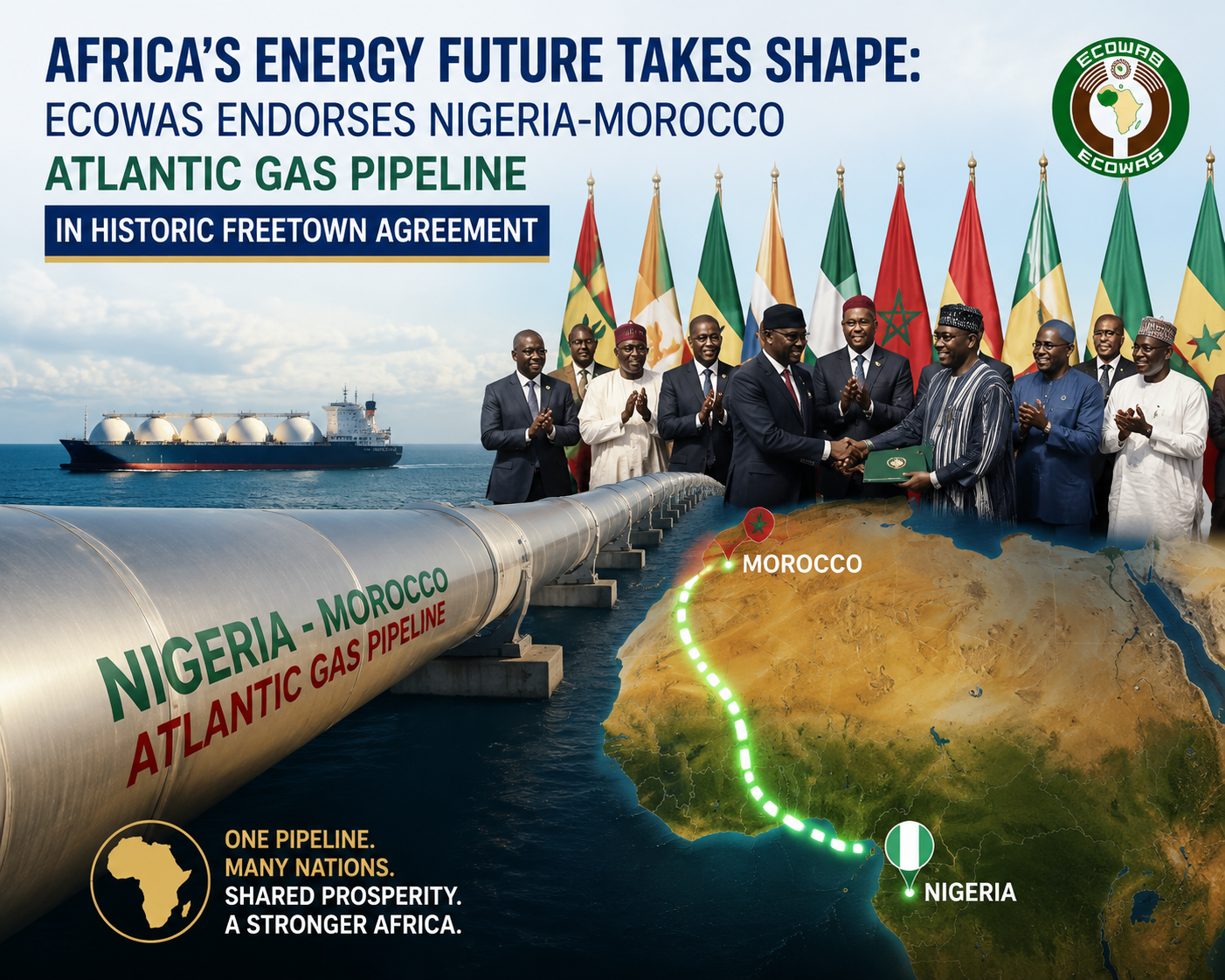
FREETOWN, Sierra Leone – July 19, 2026 — West Africa reached a defining moment in its energy and economic integration journey on Sunday as member states of the Economic Community of West African States (ECOWAS) formally signed the Intergovernmental Agreement (IGA) for the Nigeria-Morocco African Atlantic Gas Pipeline (AAGP), one of the largest infrastructure projects ever envisioned on the African continent.
The signing ceremony in Freetown represents a major institutional milestone for the ambitious project, which originated from a shared vision between His Majesty King Mohammed VI of Morocco and the late Nigerian President Muhammadu Buhari during the King’s official visit to Nigeria in 2016. The initiative continues to enjoy the full support of Nigerian President Bola Ahmed Tinubu, underscoring the enduring strategic partnership between Rabat and Abuja.
Developed jointly by Morocco’s National Office of Hydrocarbons and Mines (ONHYM) and the Nigerian National Petroleum Company Limited (NNPC Ltd.), the nearly 6,800-kilometer pipeline is designed to transport Nigerian natural gas across thirteen Atlantic coastal countries before reaching Morocco, where it will connect with the Maghreb-Europe Gas Pipeline and ultimately supply European markets.
A Landmark Step Toward Regional Integration
The agreement signed in Freetown formalizes the collective commitment of ECOWAS member states to the project’s legal and institutional framework. While Morocco is not a member of ECOWAS, it participated in the ceremony as one of the project’s founding partners and principal promoters.
Officials described the Freetown ceremony as an essential institutional step within the ECOWAS process, laying the groundwork for the project’s transition from planning to implementation.
According to project leaders, the summit demonstrates that what began as a bilateral Morocco-Nigeria initiative has evolved into a regional development project embraced by West African nations.
Royal Vision Driving Africa’s Energy Transformation
The African Atlantic Gas Pipeline remains one of the flagship projects personally championed by His Majesty King Mohammed VI, reflecting the King’s long-term vision for an integrated, prosperous, and energy-sovereign Africa.
Since its launch, the project has been viewed not merely as an energy infrastructure initiative but as a strategic platform capable of strengthening regional cooperation, economic development, and South-South partnerships across the continent.
Officials noted that the progress achieved in Freetown is a direct result of sustained political commitment at the highest levels in both Morocco and Nigeria.
Next Stop: Morocco
Although the Freetown agreement marks a significant achievement, project officials emphasized that it is not the final stage.
The next major milestone will take place in Morocco, where a formal ceremony is expected to establish the Project Management Company that will oversee the operational and financial implementation of the pipeline.
The company will be headquartered in Casablanca, while the Pipeline Higher Authority is planned for Abuja.
The upcoming ceremony is expected to bring together His Majesty King Mohammed VI, President Bola Ahmed Tinubu, and the President of Mauritania, symbolizing the project’s transition from institutional planning to full operational execution.
Morocco-Nigeria Partnership at the Core
Officials described the Morocco-Nigeria partnership as the cornerstone of the African Atlantic Gas Pipeline.
Built on years of mutual trust and shared strategic objectives, the collaboration extends beyond energy to encompass economic cooperation, political dialogue, regional security, and sustainable development.
The close coordination between ONHYM and NNPC Ltd. has been widely recognized as a successful model of South-South cooperation, demonstrating how African nations can jointly develop large-scale strategic projects for mutual benefit.
More Than a Pipeline
Estimated at approximately $25 billion, the African Atlantic Gas Pipeline is expected to transport 30 billion cubic meters of natural gas annually, supplying West African markets while also exporting significant volumes to Morocco and Europe.
Beyond energy production, the project aims to stimulate industrialization, expand electricity generation, create thousands of jobs, and diversify energy supply routes across the region.
Officials also highlighted the pipeline’s strategic importance within King Mohammed VI’s Atlantic vision, which seeks to transform the Atlantic Ocean into a corridor of cooperation linking Africa with Europe and the Americas.
Rather than serving solely as an energy network, the pipeline is envisioned as a development corridor connecting economies, facilitating trade, improving infrastructure, and strengthening regional competitiveness.
A New Chapter for West Africa
The signing of the Intergovernmental Agreement in Freetown signals a new phase for one of Africa’s most ambitious infrastructure projects.
By securing the collective endorsement of ECOWAS member states, the Nigeria-Morocco African Atlantic Gas Pipeline has evolved into a continental initiative that reflects Africa’s growing determination to strengthen energy security, deepen regional integration, and build shared prosperity through strategic cooperation.
As preparations begin for the next signing ceremony in Morocco, the project continues to move steadily toward implementation, bringing closer the vision of an interconnected West Africa powered by one of the world’s most significant cross-border energy corridors.
About the Author