The Republic of Panama has once again reaffirmed its strong support for Morocco’s autonomy initiative regarding the Moroccan Sahara, describing the proposal as the only serious, credible, and realistic basis for resolving the long-standing regional dispute. The announcement, made during a high-level diplomatic meeting in Rabat on May 22, 2026, reflects the growing international momentum behind Morocco’s position and further strengthens Rabat’s diplomatic standing on the issue.
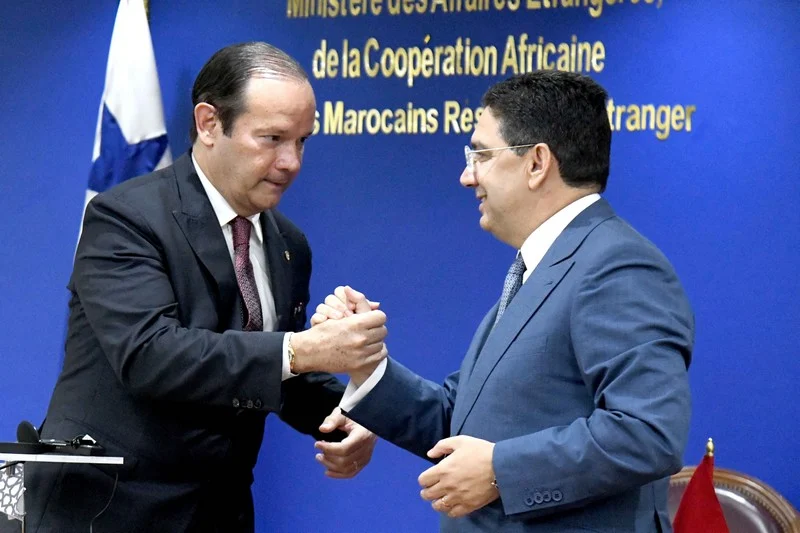
The statement came following discussions between Panamanian Vice Minister of Foreign Affairs Carlos Arturo Hoyos Boyd and Morocco’s Minister of Foreign Affairs, African Cooperation and Moroccan Expatriates, Nasser Bourita. During the meeting, Panama reiterated its unwavering commitment to Morocco’s sovereignty and territorial integrity, emphasizing that the autonomy initiative remains the most viable framework for achieving a lasting political settlement under the auspices of the United Nations.
Strengthening Bilateral Diplomatic Relations
The visit of the Panamanian vice minister to Rabat highlighted the increasingly close diplomatic relations between Morocco and Panama. Over recent years, Morocco has intensified its diplomatic outreach in Latin America, gaining support from several countries for its autonomy proposal concerning the Sahara issue. Panama’s latest declaration adds another important voice to the growing international consensus supporting Morocco’s approach.
Carlos Arturo Hoyos Boyd stressed that Panama views the autonomy initiative, proposed by Morocco in 2007, as a practical and realistic solution capable of ending decades of political deadlock. He noted that the proposal fully respects Morocco’s sovereignty while also offering a framework for local governance and regional development within the Southern Provinces.
The Panamanian official also underscored that his country supports a political process conducted exclusively within the framework of the United Nations. According to Panama, any viable solution must preserve the Kingdom of Morocco’s territorial integrity while ensuring long-term regional stability and cooperation.
Support for United Nations Security Council Resolution 2797
An important aspect of Panama’s declaration was its explicit support for United Nations Security Council Resolution 2797. The resolution reaffirmed the international community’s commitment to a realistic, pragmatic, and lasting political solution based on compromise.
Panama emphasized that Morocco’s autonomy initiative aligns perfectly with the spirit and objectives of Resolution 2797. By endorsing the resolution, Panama reinforced the view that the autonomy plan constitutes the most credible path toward resolving the dispute peacefully and sustainably.
The Panamanian government also praised the efforts of the United Nations Secretary-General and his Personal Envoy in facilitating negotiations among all parties involved. According to Hoyos Boyd, Panama remains fully committed to supporting diplomatic efforts aimed at reaching a mutually acceptable political solution within the UN-led process.
Morocco’s Expanding International Support
Morocco’s autonomy proposal has received increasing backing from countries across Africa, the Middle East, Europe, Latin America, and beyond. Many governments now consider the initiative a realistic compromise capable of balancing regional stability, economic development, and political dialogue.
The Moroccan Autonomy Plan, introduced in 2007, proposes granting broad local administrative powers to the Sahara region while maintaining Morocco’s national sovereignty. Rabat argues that this approach offers a balanced solution that respects historical ties, regional realities, and international law.
Over the years, numerous countries have opened consulates in Morocco’s Southern Provinces, particularly in Laayoune and Dakhla, signaling growing recognition of Morocco’s administration over the territory. Panama’s latest position further contributes to this evolving diplomatic landscape.
Panama Reaffirms Consular Authority Across Moroccan Territory
In a particularly significant statement, the Panamanian vice minister confirmed that Panama’s embassy in Morocco exercises full consular authority across the entirety of Moroccan territory, including the Southern Provinces. This declaration carries important diplomatic symbolism, reinforcing Panama’s practical recognition of Morocco’s administrative jurisdiction in the region.
Such acknowledgments are viewed by Moroccan officials as evidence of expanding international acceptance of the Kingdom’s sovereignty over the Sahara. Moroccan diplomacy has increasingly focused not only on political declarations but also on concrete administrative and institutional recognition from partner nations.
The Strategic Importance of the Sahara Issue
The Moroccan Sahara issue remains one of the most important diplomatic priorities for Morocco. Rabat consistently maintains that the autonomy initiative represents the only feasible solution capable of ending the conflict while safeguarding regional security and promoting economic integration in North and West Africa.
The region itself has undergone significant infrastructure and economic development over the last decade, with Morocco investing heavily in ports, renewable energy, transportation networks, fisheries, tourism, and social services. Moroccan authorities frequently point to these investments as evidence of their long-term commitment to the prosperity and stability of the Southern Provinces.
International support for the autonomy initiative has also grown amid broader geopolitical concerns about security in the Sahel and North Africa. Many countries view political stability and regional cooperation as essential for countering terrorism, illegal trafficking, and economic instability.
A Diplomatic Victory for Rabat
Panama’s renewed support is widely seen as another diplomatic success for Morocco’s foreign policy strategy. Under the leadership of King Mohammed VI, Morocco has expanded its international partnerships and reinforced support for its territorial integrity through sustained diplomatic engagement.
The meeting between Nasser Bourita and Carlos Arturo Hoyos Boyd reflects Morocco’s active diplomacy in Latin America, a region where Rabat has made significant efforts to strengthen political, economic, and cultural relations. Panama’s endorsement demonstrates that Morocco’s autonomy initiative continues to gain credibility among countries seeking pragmatic and peaceful solutions to regional disputes.
As the United Nations process continues, Morocco appears determined to consolidate international backing for its proposal while emphasizing dialogue, compromise, and regional cooperation. Panama’s latest position adds further momentum to that diplomatic trajectory and reinforces the growing perception that the autonomy initiative remains the central framework for any future resolution of the Moroccan Sahara issue.
About the Author