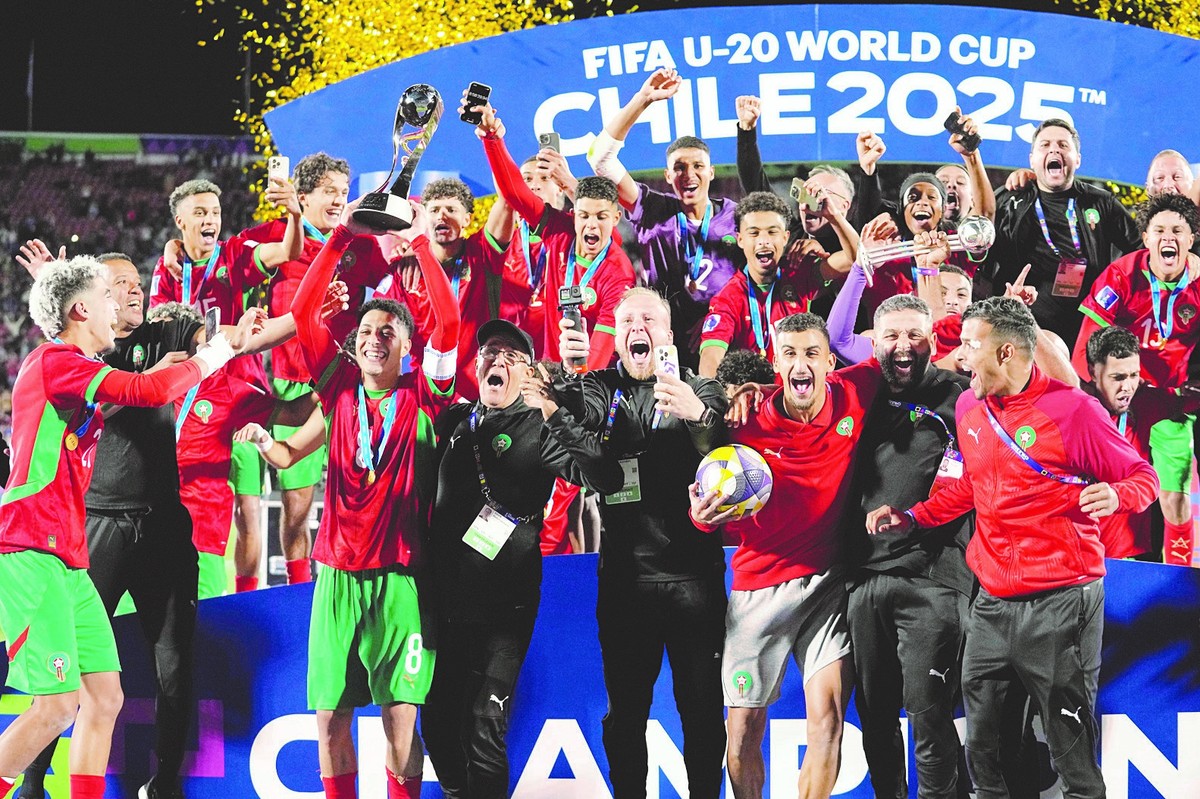
Players of Morocco celebrates with the trophy after defeating Argentina to win the FIFA U-20 World Cup final soccer match in Santiago, Chile, Sunday, Oct. 19, 2025. (AP Photo/Matias Delacroix)
Rabat, October 2025 – Morocco’s historic victory at the FIFA U-20 World Cup in Chile is far more than a sporting achievement—it is the crowning moment of a bold, long-term royal vision for national development through sports. This triumph, led by the “Lionceaux de l’Atlas,” reflects years of strategic planning, investment, and belief in Moroccan youth under the enlightened leadership of His Majesty King Mohammed VI.
A Royal Vision Realized
The U-20 squad’s success is not a matter of chance. It is the fruit of a visionary, structured, and inclusive sports policy launched and continuously supported by HM the King. Since the National Sports Conference of 2008, the Sovereign has positioned sports as a critical lever for human, social, and territorial development.
In His 2008 address, the King declared:
“We have full confidence in the great potential of Moroccan sport. We will spare no effort to support any initiative aiming at making Moroccan sport a model of excellence, a tool of social cohesion, and a vector of our national and international influence.”
The Mohammed VI Football Academy: A Model of Excellence
At the heart of this transformation lies the Mohammed VI Football Academy (AMF)—an institution that embodies the King’s vision of a sport that educates, trains, and professionalizes. Inaugurated in 2009 and reinforced after 2013, the Academy is a cornerstone of Morocco’s football renaissance.
Five members of the victorious U-20 squad trained at this world-class institution:
• Yassir Zabir
• Othmane Kountoune
• Fouad Zahouani
• Houssam Essadak
• Yassine Khalifi
With an investment of 140 million dirhams, the Academy sprawls across 18 hectares and serves as both a training ground and symbol of national ambition. It consistently produces technically and tactically sharp players who now form the backbone of national teams across age categories.
Infrastructure Development for All
Beyond elite training, HM the King’s strategy has democratized access to sport across the country. Under his leadership, Morocco has expanded local sports fields, regional training centers, and modern facilities to nurture young talent from cities to remote villages.
“Our ultimate goal is to revitalize sports in our cities, villages, and neighborhoods—especially working-class areas, which are an inexhaustible reservoir of talent,” the King emphasized in 2008.
This approach has yielded a generation of disciplined, ambitious, and confident young athletes—seen not only in the men’s game but also in the rise of Moroccan women’s football.
A Strategy Bearing Fruit Across All Levels
The U-20 title comes as part of a broader surge in Moroccan football. The historic run of the senior national team at the 2022 FIFA World Cup in Qatar, the women’s team’s first-ever World Cup appearance and continental final, and continued youth-level success all reflect the effectiveness of the national sports framework.
Coach Mohamed Ouahbi, after the 2-0 final victory over Argentina, praised HM the King’s foresight:
“His Majesty laid the foundations for a true football renaissance. The Academy and regional sports federations are examples of that vision.”
Ouahbi emphasized that the victory is not only a title but the culmination of years of investment and structural reform. His players, who overcame world-class teams like Spain, Brazil, the USA, and France, are the product of a long-term approach rooted in modern training and tactical discipline.
National Pride and Continental Prestige
The impact of this victory goes beyond sport. It has united Moroccans across generations and regions, with fans celebrating passionately in Rabat, Casablanca, Fès, Laâyoune, Oujda, and beyond. From cafés and public squares to homes and workplaces, the entire nation vibrated with patriotic pride as the final unfolded late into the night.
Supporters described the team’s journey as “historic,” “unprecedented,” and “a dream come true.” The streets were filled with flags, chants, and emotional displays of citizenship and unity.
This national euphoria was echoed by HM the King himself, who sent a heartfelt message of congratulations to the players and staff.
“You have honored your country and the youth of Africa,” the King wrote, “filling us with immense joy and pride.” He praised their unity, professionalism, and unwavering belief in themselves, highlighting the symbolic weight of this victory in projecting Moroccan talent on the world stage.
A Triumph of Vision, Not Just Talent
What makes this achievement exceptional is that it’s not simply the result of one team’s effort—it is the product of an ecosystem. From grassroots fields to international tournaments, from institutional reforms to technical preparation, Morocco has steadily built a self-sustaining football model. The U-20 World Cup is merely the latest and most visible fruit of this journey.
Coach Ouahbi summed it up perfectly:
“This success is not only a historic trophy. It is the outcome of a long-term structural reform driven by HM the King—a process that has transformed dreams into reality, and ambitions into global recognition.”
Looking Ahead
With this title, Morocco becomes a pioneer in African and Arab football, achieving a milestone never before reached by the nation. It marks a turning point, and a signal that Moroccan football, guided by the King’s enduring commitment, is not only back on the global map—but is helping redraw it.
The challenge now is to sustain this momentum, continuing to nurture young talent, strengthen national leagues, and deepen public access to sports. In the words of HM the King:
“Remain steadfast, dedicated, and faithful to the path you have begun. The future belongs to you.”
Conclusion
The U-20 World Cup victory is not an isolated miracle—it is a symbol of national renewal through sport. It honors the vision, leadership, and investment of His Majesty King Mohammed VI and celebrates the talent, unity, and resilience of Morocco’s youth.
As the Lionceaux de l’Atlas lift the trophy in Santiago, a nation lifts its eyes to a future bright with promise—and a footballing legacy that is just beginning to unfold.
About the Author