What happened in Ceuta this summer should be a wake-up call, not just another headline that fades in a week.
At the end of July, tens of thousands of people crossed into Ceuta from Morocco in the span of a few days. Some reports put the number as high as 70,000, with dozens dying in the crush at the breakwater and in the water. And this wasn’t only Moroccans crossing over, like a lot of the coverage made it sound. There were Sudanese, Algerians, Somalis, Senegalese, Malians, Egyptians — people from all over Africa who had been staged in Morocco and used this moment to push through. That matters, because it shows this wasn’t just an internal Spain-Morocco migration story, it was a much bigger regional movement of people that Morocco’s own territory was being used to launch.
This wasn’t a normal, gradual flow of people either — it happened too fast and too organized-looking for that. Spanish officials, including Ceuta’s own regional president, said openly that this looked encouraged, maybe even orchestrated, by Moroccan authorities. Morocco denies it. But the border guards who are usually there simply weren’t, in the days before it happened. That doesn’t happen by accident.
And here’s where I think the real story is: this didn’t come out of nowhere. Just days before the crossings, Spanish Prime Minister Pedro Sánchez had traveled to Algeria and announced a “new phase” in relations between Madrid and Algiers. Algeria and Morocco are rivals — they’ve had no diplomatic relations for years, mainly over Western Sahara. So when Spain goes and rebuilds ties with Morocco’s biggest rival, without working things out with Morocco first, it’s not hard to see why Rabat took it as a slap in the face. Whether or not Morocco directly opened the gates, the timing tells you everything about the mood.
This is my view: Spain made a mistake by trying to manage its Morocco relationship by going around Morocco instead of through it. If Madrid has an issue with how things stand — whether it’s about migration, Western Sahara, or anything else — the smart move is to sit down with your actual neighbor and work it out directly. Algeria is not the neighbor here. Morocco is. You don’t fix a problem with the person next door by getting closer to the person they don’t get along with. That’s not diplomacy, that’s provocation, and provocations like this get people killed. We saw that this summer.
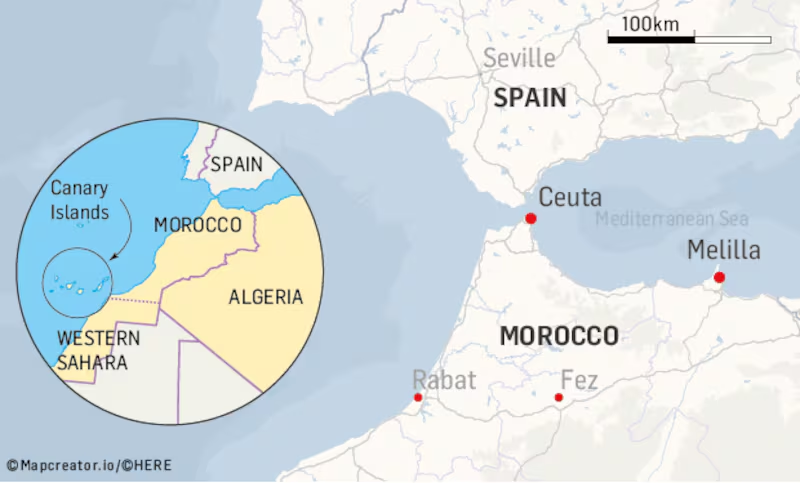
There’s another piece of this that I think gets missed by a lot of people outside the region: many people around the world genuinely don’t realize that Ceuta and Melilla sit on Moroccan land. They’re Spanish-administered, but geographically and historically they are Morocco — cities on the Moroccan coast that Spain took hold of centuries ago and never gave back. Morocco has never dropped that claim. Since independence in 1956, Rabat has kept raising it, at the UN, in diplomacy, in public statements, generation after generation, the same way it has never let go of its position on Western Sahara. This isn’t some fringe grievance Morocco brings up when it’s convenient — it’s a long, consistent fight to get its own land back that the rest of the world mostly ignores because Spain is the one holding the pen on how this gets described internationally. To a lot of people watching this crisis unfold, the fact that these are Moroccan cities under foreign control came as a genuine surprise. I think that says something about how one-sided the framing usually is.
And there’s a basic geographic point that gets lost too: when those people crossed into Ceuta, they didn’t leave Africa. They’re still standing on the African continent. Ceuta and Melilla are not islands off the coast of Spain — they’re physically part of North Africa, surrounded by Moroccan land and Moroccan waters. So calling this a “border crossing into Europe” is misleading. It’s people moving within Africa, into a foreign-controlled city sitting inside their own continent. That’s a very different situation than someone crossing the Mediterranean, but it gets talked about as if it’s the same thing.
That also gets to why I don’t think Morocco owes Spain anything here. Morocco isn’t obligated to act as Spain’s private security guard on a piece of Moroccan land that Spain took by force centuries ago and never returned. Spain benefits enormously from Morocco quietly policing that border on its behalf, year after year, and treats it like an automatic service it’s entitled to. It isn’t. If Spain wants a reliable partner controlling that border, that partnership has to be earned through real diplomacy and respect for Morocco’s position, not assumed as a given while Madrid goes and cozies up to Rabat’s rival on the side.
Still, there’s a piece of this that goes beyond Spain and Morocco alone: Europe cannot treat this as a Spain-only problem. Ceuta is an EU external border. When tens of thousands of people cross it in a matter of days, that’s not just Spain’s headache, that’s a Schengen-wide alarm bell, and other EU governments already reacted to it that way. If Morocco decides to lean on its border controls again the next time it’s unhappy with Madrid, the rest of Europe is going to feel it too. Brussels has a real interest in making sure Spain and Morocco aren’t left to sort this out through migration pressure and public blame-trading. Nobody benefits from treating a strategic North African neighbor as a problem to be managed instead of a partner to be dealt with honestly.
Spain has a choice going forward. It can keep trying to balance Morocco and Algeria against each other and hope nothing blows up again, or it can go back to Rabat, have the harder conversation, and actually fix the relationship at its source. Based on everything that’s happened this summer, I don’t think the first option is sustainable much longer.
About the Author