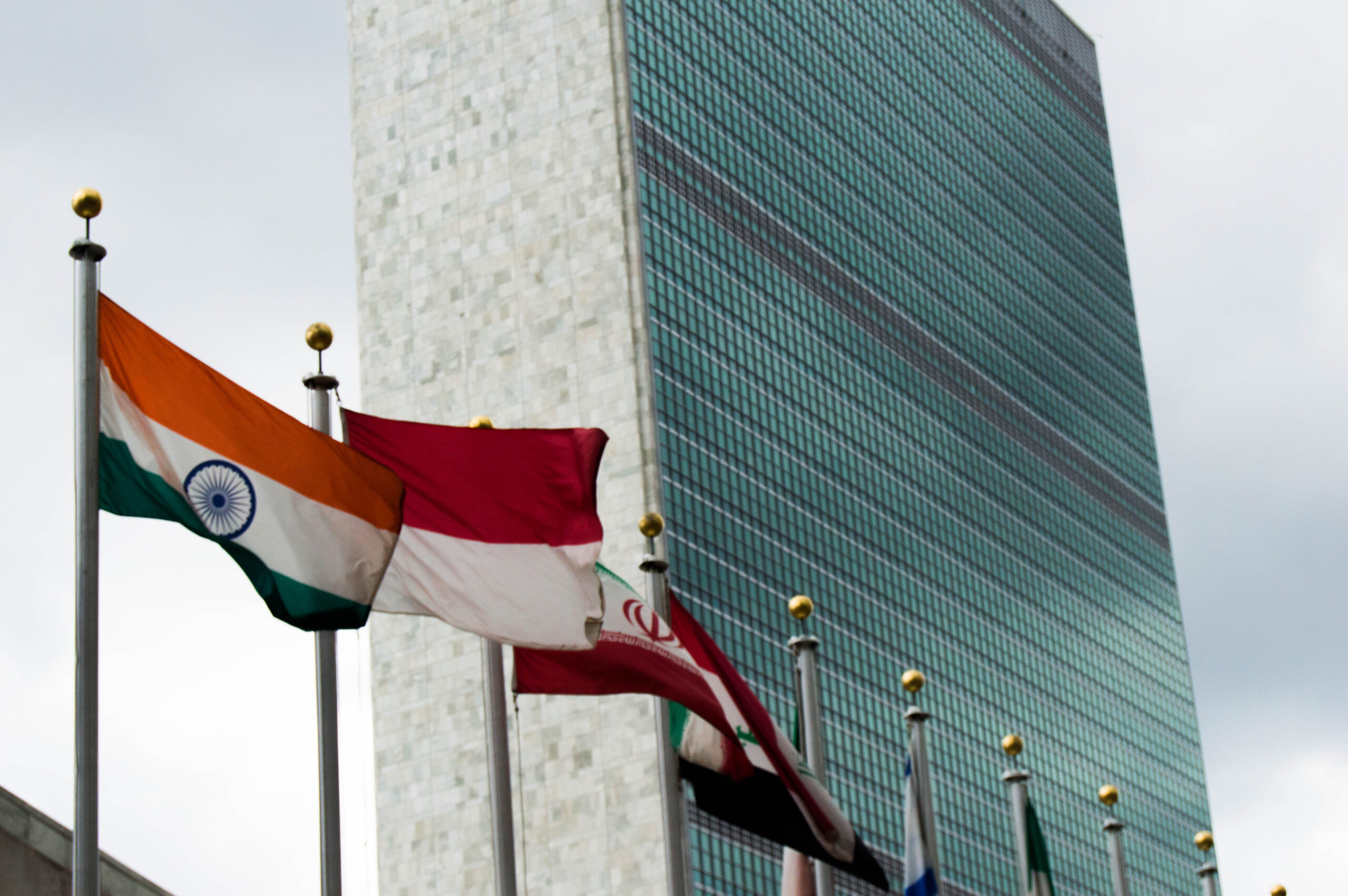
Illustrative image: flags outside United Nations headquarters in New York. Photograph by Erick Irani, via Wikimedia Commons, licensed under CC BY 2.0.
World Media Feed Editorial Team | November 24, 2026
An estimated 47,000 women and girls were killed by an intimate partner or another family member around the world in 2025, an average of about 129 victims every day, according to new figures released by UN Women and the United Nations Office on Drugs and Crime (UNODC).
The estimate means that roughly five women or girls were killed every hour by someone close to them. The agencies said these killings accounted for about 60% of the 78,000 women and girls intentionally killed worldwide during the year, underscoring how frequently lethal violence against women occurs within family and intimate relationships.
Africa recorded the highest regional toll
Africa had the largest estimated number of victims, at 22,100. Asia followed with 15,100, the Americas with 7,400, Europe with 2,100 and Oceania with 300.
When measured against the female population, Africa also recorded the highest estimated rate, at 2.9 victims per 100,000 women and girls. The rate was 1.4 in the Americas, 1.1 in Oceania, 0.6 in Asia and 0.5 in Europe.
The regional totals do not mean that every country faces the same risk. They are broad estimates, and gaps in national reporting make comparisons less precise in some parts of the world.
A lower estimate does not prove progress
The 2025 estimate is lower than the approximately 50,000 women and girls recorded in the 2024 estimate. UN Women and UNODC cautioned that the difference largely reflects changes and improvements in the availability of country-level data, rather than evidence that killings have meaningfully declined.
The figures are estimates, not a complete count of every case. The agencies draw on available national statistics and statistical methods to address missing information. The limitations are particularly important when assessing killings outside the family or domestic sphere, where data remain incomplete.
The report also points to a wider pattern: while homicide rates have declined, rates of killings of women by intimate partners or family members have fallen more slowly, particularly in the Americas and Europe. Women accounted for about 19% of homicide victims worldwide in 2025; among female homicide victims, 60% were killed in the private sphere. The comparable share for male homicide victims was 11%.
The prevention and accountability challenge
The findings were released ahead of the International Day for the Elimination of Violence against Women on November 25 and the annual 16 Days of Activism campaign. UN Women has called for stronger prevention, protection for survivors and greater accountability for perpetrators.
At United Nations headquarters in New York, an installation of 129 orange flags was organized to represent the estimated daily toll. The display is intended to make visible a statistic that can otherwise be reduced to an annual figure.
For governments, the figures raise questions that extend beyond criminal penalties after a killing: whether warning signs are identified, whether survivors can safely seek help, whether protection orders are enforced and whether support services are available before violence becomes fatal.
The UN estimates cannot describe every national situation or explain the circumstances of each death. They do, however, show that lethal violence by partners and relatives remains a persistent global problem—and that better data, prevention and access to protection are essential to measuring whether policies are working.
Sources
- UN Women: 2026 Femicide Brief findings and regional estimates
- United Nations: Five women killed every hour by partners or family members
- Deutsche Welle, with AFP and dpa: Report findings and international context
- RTÉ: Independent coverage of the UN figures
Image note: The photograph shows national flags outside United Nations headquarters and is illustrative; it is not a photograph of the 129-flag installation. Photo: Erick Irani via Wikimedia Commons, CC BY 2.0.
About the Author
