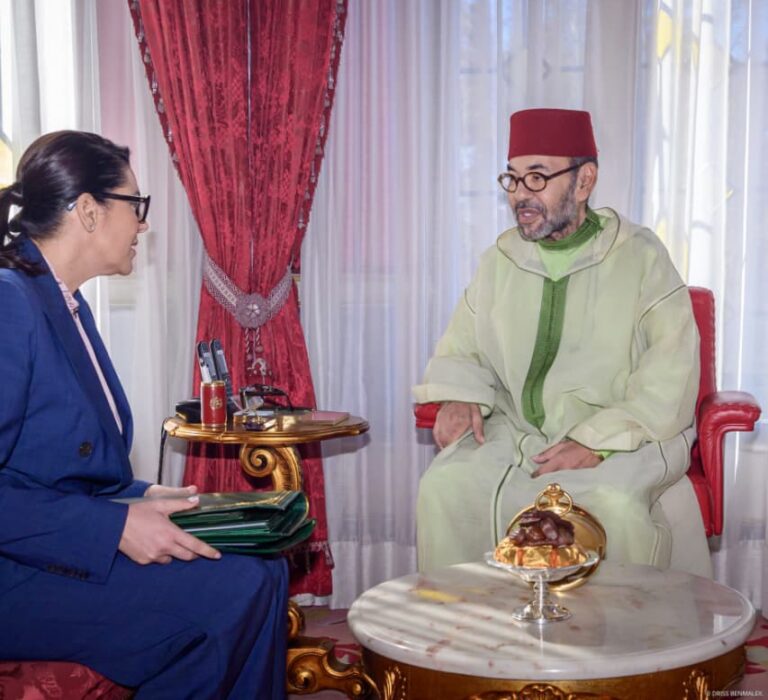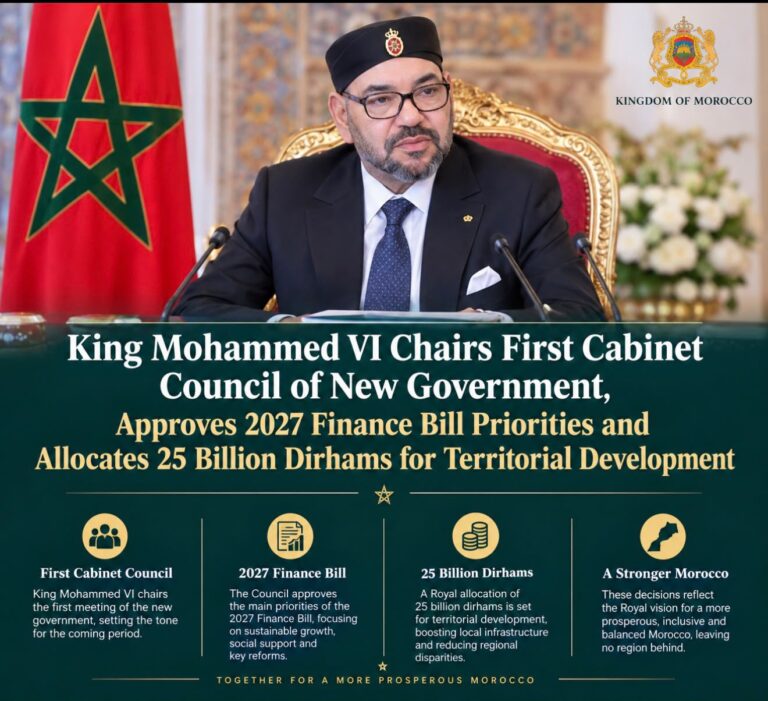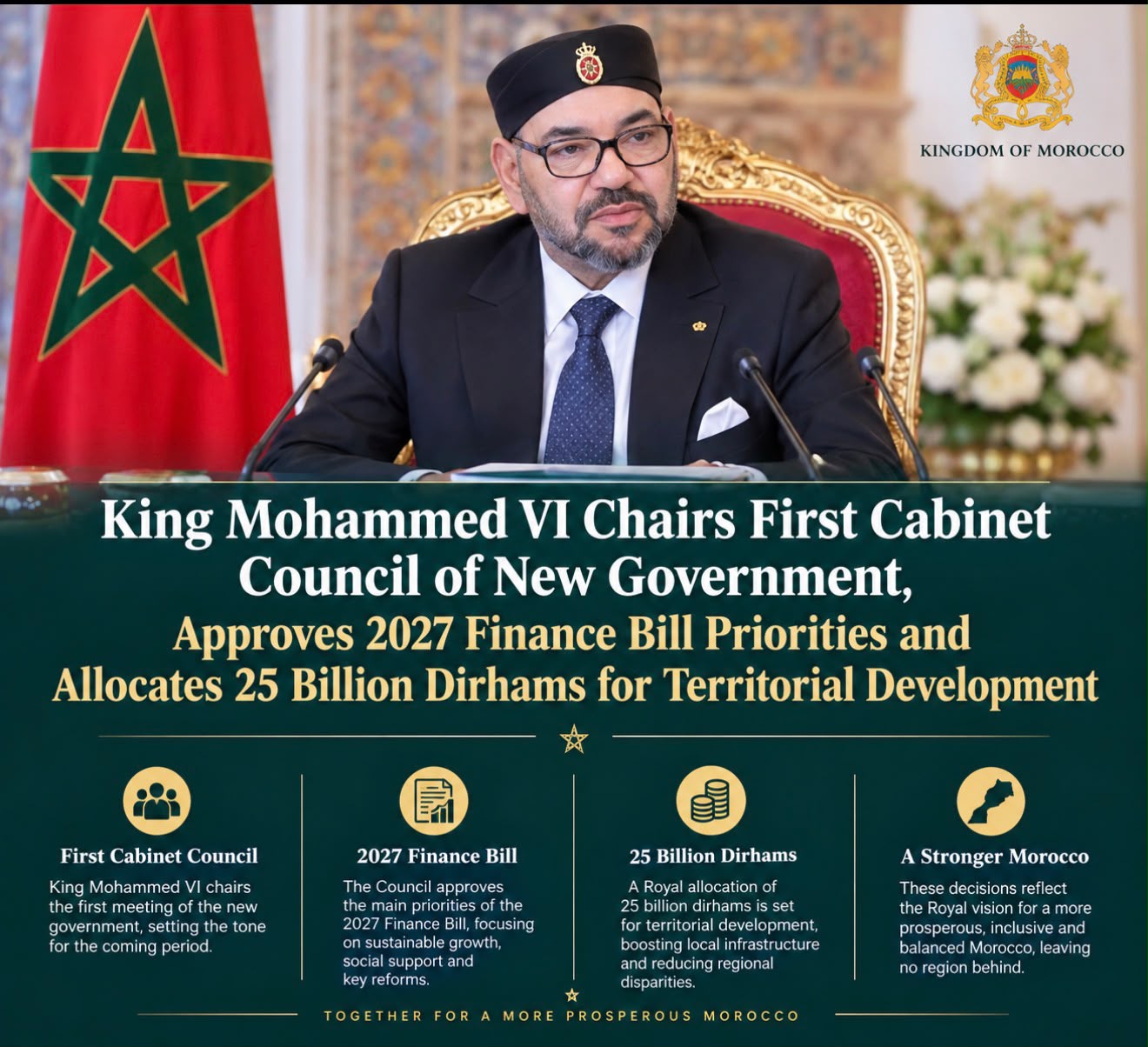
RABAT, Morocco — October 17, 2026 — King Mohammed VI, accompanied by Crown Prince Moulay El Hassan, chaired a Council of Ministers at the Royal Palace in Rabat on Saturday, approving the general guidelines of Morocco’s Draft Finance Bill for 2027. The meeting marks the first ministerial council of the new government, which took office on Friday, October 16.
According to a statement from the Royal Cabinet, the meeting focused on the government’s economic and social priorities for the coming fiscal year, with particular emphasis on purchasing power, youth employment, regional development, strategic sovereignty and sustainable economic growth.
The 2027 Finance Bill comes at a time of heightened international uncertainty, driven by geopolitical conflicts, growing protectionist policies and intensifying global competition for energy, technology and financing.
Despite these challenges, Morocco expects its economy to record growth of 4.7% by the end of 2026, while inflation is projected to remain at 0.7%. The budget deficit is also expected to decline to 3% of gross domestic product (GDP), according to the presentation delivered by the Minister of Economy, Finance and Public Administration, Fouzi Lekjaa.
The government says the proposed financial framework aims to preserve macroeconomic stability while accelerating social reforms and investment in strategic sectors.
Five Strategic Priorities for Morocco’s 2027 Budget
The Draft Finance Bill establishes five major priorities designed to strengthen Morocco’s economic resilience and address the needs of its population.
1. Protecting Purchasing Power and Strengthening the Social State
Improving living standards and protecting household purchasing power are among the government’s central objectives for 2027.
A structural reform of markets and pricing mechanisms is scheduled to begin in 2027, accompanied by measures intended to ease financial pressure on citizens and strengthen the country’s social protection system.
The government plans to continue expanding universal health coverage while ensuring the long-term financial sustainability of its schemes. The direct social assistance program is also expected to receive increased support.
Further investment will target the modernization of public healthcare and education systems, alongside efforts to improve access to decent housing through Morocco’s direct housing assistance program.
These measures reflect the government’s stated objective of combining economic growth with stronger social protection and more effective public services.
2. Creating Better Opportunities for Young People
Youth employment and economic inclusion represent another major pillar of the 2027 budget.
The government intends to launch an integrated national youth program covering the 2027–2031 period. The initiative is expected to connect education, vocational training, entrepreneurship and employment opportunities through a coordinated national framework.
The program will focus on guiding young people toward suitable training pathways, supporting business incubation and facilitating access to financing, guarantee mechanisms and markets.
The government also recognizes the limitations of fragmented initiatives managed separately across different sectors. Its stated ambition is to establish a more coordinated policy that follows young people throughout their transition from education and training to employment and housing.
By linking these stages, the authorities aim to provide young people with greater economic security and social stability.
The emphasis on youth comes as Morocco seeks to ensure that economic development translates into practical opportunities for a new generation entering the labor market.
3. Accelerating Regionalization and Territorial Development
The third priority focuses on strengthening regional governance and accelerating integrated territorial development.
In line with the King’s directives, the government plans to clarify the responsibilities of regional authorities, improve administrative efficiency and reinforce coordination between the central government and regional administrations.
The proposed approach will rely on clearer divisions of responsibility, stronger coordination mechanisms and contractual arrangements between the state and the regions.
The government also intends to fully implement the National Charter on Administrative Deconcentration, which seeks to bring decision-making and public administration closer to citizens and local communities.
A major financial commitment accompanies this objective: approximately 25 billion dirhams will be mobilized to accelerate the implementation of the new generation of integrated territorial development programs.
The allocation is intended to support development projects across Morocco’s regions and strengthen the implementation of local development strategies.
The emphasis on territorial development highlights the government’s intention to address regional disparities and improve access to opportunities and public services beyond the country’s largest economic centers.
4. Strengthening Water, Energy, Food and Digital Sovereignty
Strategic sovereignty is another key component of the 2027 Finance Bill, reflecting Morocco’s efforts to reduce vulnerabilities in essential sectors.
Water security remains a central concern, particularly as the country faces growing pressure on water resources. The government intends to reinforce measures designed to safeguard water supplies and strengthen long-term resilience.
In the energy sector, the budget will support the acceleration of renewable energy development and the continued implementation of Morocco’s green hydrogen offering.
The government also plans to advance the gradual implementation of its gas infrastructure roadmap, with the broader objective of diversifying energy resources and strengthening national energy security.
Food security will receive additional attention through measures intended to protect the country’s capacity to meet its strategic needs.
Digital sovereignty is also included among the priorities, reflecting the growing importance of technological infrastructure, digital capabilities and national control over critical digital systems.
Together, these measures are intended to strengthen Morocco’s resilience in the face of international disruptions affecting essential resources, supply chains and technological development.
5. Building a Stronger Economy to Finance Social Ambitions
The fifth priority seeks to build a competitive and resilient economy capable of financing Morocco’s social commitments and strategic development ambitions.
The government plans to accelerate institutional reforms, preserve macroeconomic and budgetary stability, and mobilize the financial resources required to advance major development projects and sectoral strategies.
Particular attention will be given to developing new industrial ecosystems in strategic sectors, with the aim of strengthening domestic productive capacity and reducing dependence on external suppliers in key areas.
The approach reflects the government’s view that sustainable social progress depends on a strong economic foundation capable of generating investment, employment and public revenue.
Maintaining fiscal discipline while financing major infrastructure and development programs will therefore remain an important challenge as the 2027 budget moves forward.
Private Investment and Small Businesses in Focus
Beyond the five main priorities, the Draft Finance Bill places significant emphasis on private investment as a driver of economic growth and job creation.
The government intends to reinforce support mechanisms established under Morocco’s Investment Charter and continue reforming Regional Investment Centers.
Small and medium-sized enterprises, including very small businesses, are expected to receive particular attention.
These companies play an important role in employment, entrepreneurship and local economic activity. Improving their access to financing, investment support and markets could help expand their contribution to Morocco’s economy.
The proposed measures also seek to encourage private-sector participation in national development projects and strengthen the conditions necessary for new businesses to emerge and existing companies to grow.
The government’s broader objective is to create an economic environment in which private investment complements public spending and helps finance the country’s long-term social and economic ambitions.
A New Government Faces Major Economic and Social Expectations
The Council of Ministers comes just one day after the new government took office, placing the 2027 Finance Bill among its first major policy priorities.
The international environment presents significant challenges, including geopolitical instability, rising competition for strategic resources and uncertainty surrounding global financing and trade.
Against this backdrop, Morocco’s projected growth of 4.7% in 2026 and the expected reduction of the budget deficit to 3% of GDP provide the economic context for the government’s next phase of planning.
However, the success of the proposed budget will ultimately depend on implementation, the effective use of public resources and the extent to which announced measures improve citizens’ everyday lives.
For households, the key questions will include whether social assistance becomes more effective, whether access to healthcare and education improves, and whether housing remains affordable.
For young people, the central test will be whether the proposed national program creates meaningful pathways into employment and entrepreneurship.
For businesses and regional authorities, the priorities will include access to financing, administrative efficiency and the delivery of development projects.
From Budget Priorities to Concrete Results
The 2027 Finance Bill outlines an approach that seeks to balance social protection, economic competitiveness and strategic independence.
The commitment of 25 billion dirhams to integrated territorial development stands out as one of the announcement’s most significant financial elements. Alongside planned reforms in healthcare, education, housing, energy, water management and youth employment, it signals an effort to connect national economic policy with local development needs.
The proposed framework also reflects a broader recognition that economic growth alone is insufficient unless its benefits translate into stronger public services, employment opportunities and improved living conditions.
As the new government begins its work, the coming budget process will be closely watched for how these priorities are translated into concrete programs, funding decisions and measurable outcomes.
The Council of Ministers chaired by King Mohammed VI has established the general direction of the 2027 Finance Bill. The next challenge will be to turn those commitments into tangible results for Moroccan citizens and communities across the country.
Source: Royal Cabinet statement on the Council of Ministers held in Rabat on October 17, 2026.
About the Author