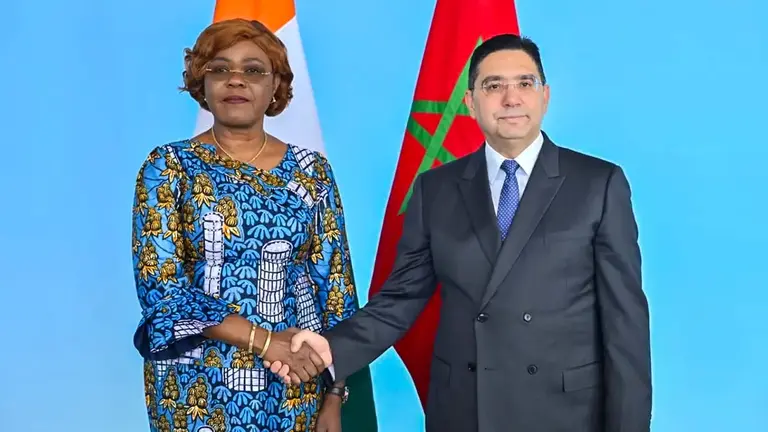
Relations between the Kingdom of Morocco and the Republic of Côte d’Ivoire continue to deepen as both nations reaffirm their commitment to strategic cooperation, African solidarity, and regional stability. During high-level diplomatic talks held in Rabat on May 21, 2026, Côte d’Ivoire once again expressed its unwavering support for Morocco’s territorial integrity and sovereignty over all of its national territory, including the Sahara region.
The reaffirmation came in a Joint Communiqué issued after discussions between Morocco’s Minister of Foreign Affairs, African Cooperation and Moroccan Expatriates, Nasser Bourita, and Côte d’Ivoire’s Minister of State and Minister of Foreign Affairs and International Cooperation, Nialé Kaba. The visit marked Kaba’s first official working mission to the Kingdom and highlighted the growing diplomatic convergence between Rabat and Abidjan on major regional and continental issues.
A Firm and Consistent Position
During the meeting, the Ivorian side reiterated what it described as a constant and principled position regarding Morocco’s territorial integrity. Côte d’Ivoire emphasized that it fully supports Moroccan sovereignty over its entire territory, including the Sahara region, a stance that has remained unchanged over the years despite shifting geopolitical dynamics in North Africa and the Sahel.
The declaration reflects the increasing number of African and international partners endorsing Morocco’s position on the Sahara issue. Côte d’Ivoire has consistently aligned itself with Rabat’s diplomatic vision, viewing Morocco’s approach as a realistic framework capable of ensuring long-term peace, stability, and development in the region.
For Morocco, such support from influential African nations carries substantial political and diplomatic significance. It demonstrates growing continental backing for Morocco’s autonomy initiative and reinforces Rabat’s efforts to strengthen South-South cooperation throughout Africa.
Support for Morocco’s Autonomy Plan
A key aspect of the talks centered on the Moroccan Autonomy Plan for the Sahara, which Côte d’Ivoire once again endorsed. The initiative, proposed by Morocco as a political solution to the regional dispute, seeks to grant broad autonomy to the Sahara region while maintaining Moroccan sovereignty over the territory.
According to Ivorian officials, the plan represents a serious, credible, and pragmatic basis for resolving the issue through dialogue and political consensus. Abidjan’s renewed support aligns with the position of numerous countries that increasingly regard the autonomy initiative as the most viable path toward a lasting settlement.
The discussions also referenced the importance of regional stability and economic development in Africa. Both countries stressed that sustainable peace in the Sahara region would contribute to broader security cooperation, trade expansion, and investment opportunities across the continent.
Recognition of United Nations Security Council Resolution 2797
In another major development, Côte d’Ivoire welcomed the adoption of United Nations Security Council Resolution 2797 on October 31, 2025. The resolution marked a significant diplomatic milestone by endorsing, within the framework of Moroccan sovereignty, the autonomy plan presented by the Kingdom as the only serious and lasting basis for a political solution to the Sahara dispute.
The resolution has been widely interpreted as an important shift in international momentum surrounding the issue. Morocco considers the adoption of Resolution 2797 to be a validation of its diplomatic efforts and a recognition of its approach by the international community.
Côte d’Ivoire’s endorsement of the resolution further strengthens Morocco’s position on the global stage. It also demonstrates growing African support for initiatives aimed at preserving regional stability while respecting national sovereignty.
Strategic Partnership Between Rabat and Abidjan
The meeting between Bourita and Kaba also underscored the strength of the longstanding partnership between Morocco and Côte d’Ivoire. Over the past decade, relations between the two nations have expanded significantly across political, economic, cultural, and security sectors.
Morocco has become one of the leading African investors in Côte d’Ivoire, particularly in banking, telecommunications, infrastructure, and agriculture. Meanwhile, Côte d’Ivoire has emerged as one of Morocco’s most important partners in West Africa.
During the talks, Bourita expressed Morocco’s gratitude for Côte d’Ivoire’s consistent support on the Sahara issue, describing it as a reflection of the deep trust and fraternity linking the two countries.
He also highlighted the symbolic importance of Côte d’Ivoire’s decision to open a Consulate General in the city of Laayoune on February 18, 2020. The opening of the diplomatic mission was viewed as a concrete demonstration of Abidjan’s recognition of Morocco’s sovereignty over the Sahara region and its commitment to strengthening bilateral cooperation.
Expanding African Cooperation
The Rabat meeting further illustrated Morocco’s broader diplomatic strategy in Africa, which focuses on reinforcing partnerships based on mutual respect, economic collaboration, and political solidarity. Under this approach, Morocco has intensified engagement with numerous African states while promoting investment, infrastructure projects, and development initiatives throughout the continent.
Côte d’Ivoire, as one of West Africa’s fastest-growing economies and a key regional actor, occupies a central place in Morocco’s African policy. The two nations continue to cooperate closely within African institutions and on issues related to peacekeeping, counterterrorism, migration, and economic integration.
Observers note that the continued alignment between Rabat and Abidjan may also influence broader African diplomatic trends concerning the Sahara issue. Increasingly, African nations are expressing support for negotiated political solutions centered on autonomy and regional stability rather than prolonged confrontation.
A Shared Vision for Stability and Development
Beyond the diplomatic declarations, the meeting reflected a shared vision between Morocco and Côte d’Ivoire regarding the future of Africa. Both countries emphasized the importance of unity, sovereignty, and intra-African partnerships as essential pillars for the continent’s progress.
Their growing cooperation demonstrates how bilateral alliances can contribute to regional peace and economic transformation. Through sustained diplomatic engagement and strategic collaboration, Rabat and Abidjan continue to position themselves as influential partners committed to stability and development across Africa.
As international discussions on the Sahara issue continue, Côte d’Ivoire’s reaffirmation of support for Morocco’s territorial integrity and autonomy initiative represents another significant diplomatic victory for the Kingdom. It also highlights the enduring strength of the relationship between the two countries and their shared commitment to fostering peace, cooperation, and prosperity throughout the African continent.
About the Author