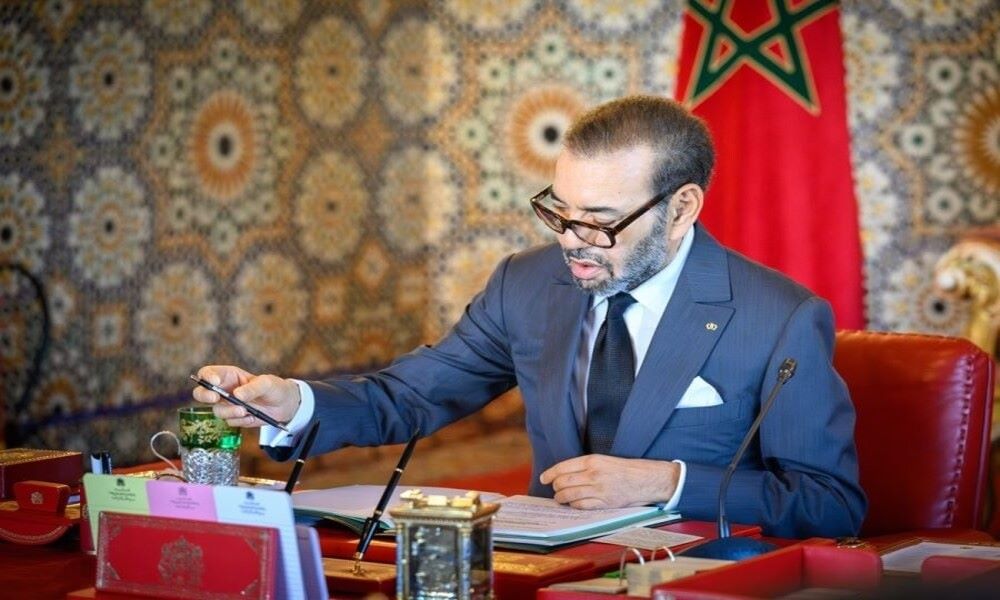
MARRAKECH, June 13, 2023 — King Mohammed VI of Morocco called for stronger international cooperation to promote interfaith dialogue, religious tolerance and peaceful coexistence in a royal message addressed to participants in the Parliamentary Conference on “Interfaith Dialogue: Working Together for Our Common Future,” held in Marrakech from June 13 to 15, 2023.
The message was read on the King’s behalf by Rachid Talbi El Alami, President of Morocco’s House of Representatives, before an international gathering of parliamentarians, religious leaders, scholars and representatives of institutions from around the world.
The conference was organized by the Moroccan Parliament in cooperation with the Inter-Parliamentary Union (IPU).
A Call to Move Beyond Dialogue
In his message, King Mohammed VI emphasized that interfaith dialogue must lead to practical initiatives capable of strengthening understanding and cooperation between religious communities.
He called for renewed approaches to relations between followers of different faiths, based on peace, mutual respect and the rejection of intolerance.
The King also urged participants to confront the growing influence of extremism, hatred and discrimination, warning against attempts to portray international tensions as an inevitable conflict between religions or civilizations.
Referring to a position he had expressed more than two decades earlier, he described the challenge facing the world not simply as a clash of civilizations, but as a clash of “ignorances.”
The message stressed that religious beliefs should not be used to justify violence, persecution or hostility toward others.
Parliamentarians and Religious Leaders Have a Shared Responsibility
The King highlighted the different but complementary responsibilities of political institutions and religious authorities.
Parliamentarians, he said, have the ability to introduce legislation that encourages dialogue and counters discrimination and intolerance.
Religious leaders and institutions, meanwhile, have an important role in education, guidance and raising public awareness.
He also called for a joint mechanism coordinated by the Inter-Parliamentary Union to make interfaith dialogue a shared objective within the international community.
Such a mechanism, according to the royal message, could help promote dialogue in international forums and strengthen respect for pluralism and cultural diversity in democratic institutions.
Morocco’s History of Religious Coexistence
The royal message also highlighted Morocco’s historical experience of religious and cultural diversity.
King Mohammed VI referred to the coexistence of Muslims, Jews and Christians in Morocco and recalled the protection offered by his grandfather, the late King Mohammed V, to Moroccan Jews during the period of persecution under the Vichy regime.
He also referred to the policies of his father, the late King Hassan II, in maintaining the protection and recognition of Morocco’s Jewish community.
The message presented this historical experience as part of Morocco’s broader commitment to religious coexistence and mutual respect.
It also highlighted institutions established to promote religious moderation and education, including the Higher Council of Ulema, the Mohammed VI Institute for the Training of Imams, Murshidin and Murshidat, the Mohammedia League of Ulema and the Mohammed VI Foundation of African Ulema.
An International Gathering in Marrakech
The Marrakech conference brought together parliamentary representatives and religious figures to examine how dialogue between faith communities could contribute to peace and international cooperation.
The Inter-Parliamentary Union described the gathering as an opportunity to bring legislators and religious leaders together to develop approaches for addressing intolerance and strengthening peaceful coexistence.
The conference also produced the Marrakesh Communiqué, setting out conclusions and recommendations from the discussions.
A Message With International Relevance
The King’s address placed responsibility for promoting coexistence not only on governments, but also on parliaments, religious institutions, educational establishments, the media and civil society.
Its central argument was that dialogue cannot remain a diplomatic or symbolic exercise. It must be reflected in education, public policy, institutional cooperation and the treatment of people regardless of their religious or cultural backgrounds.
As the Marrakech conference brought together representatives from different parts of the world, Morocco used the occasion to place religious coexistence and international dialogue at the center of a wider discussion about humanity’s shared future.
World Media Feed Editorial Team
Historical report based on the Royal Message delivered on June 13, 2023, and official documentation from Morocco’s Parliament and the Inter-Parliamentary Union.
Primary sources
- Morocco.ma — Full text of the Royal Message.
- Moroccan House of Representatives — Royal Message.
- Inter-Parliamentary Union — Parliamentary Conference on Interfaith Dialogue and conference documents.
About the Author