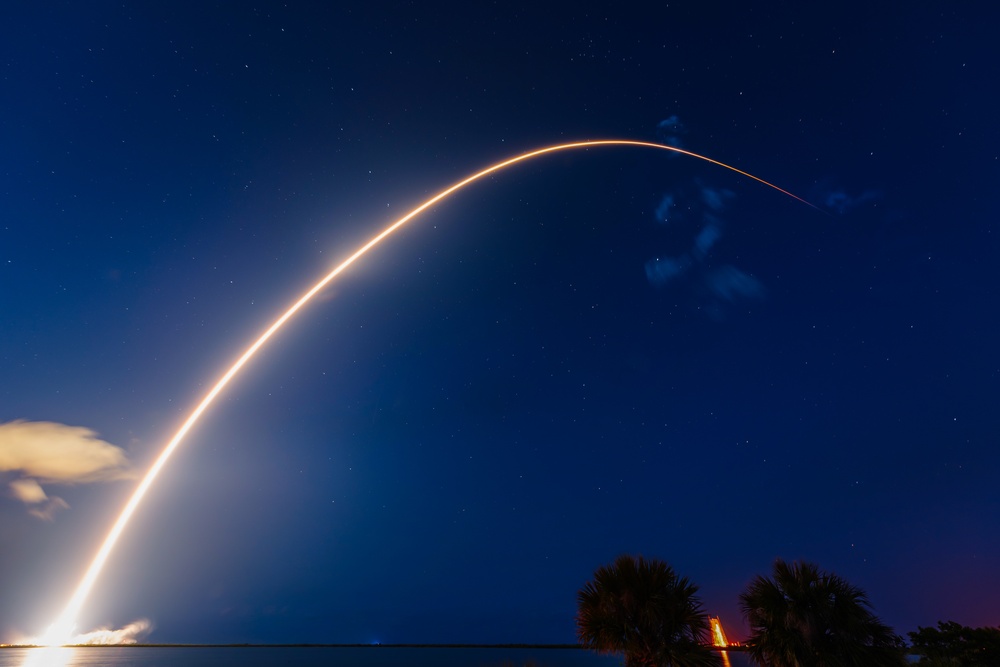
File photograph: A Falcon 9 rocket carrying Starlink satellites lifts off from Cape Canaveral in May 2024. U.S. Space Force photo by Joshua Conti / DVIDS, public domain.
The Federal Communications Commission has authorized SpaceX to deploy a proposed constellation of up to one million satellites designed to function as data centers in low Earth orbit, giving Elon Musk’s company a major regulatory step toward moving some artificial-intelligence computing infrastructure into space.
The FCC’s Space Bureau issued the authorization on November 25 for the system, named Starmind. The decision is historic in scale, but it does not mean a million satellites are ready to launch. SpaceX must meet a series of deployment milestones over the next 14 years, and important technical, financial and environmental questions remain.
What the FCC actually approved
The order authorizes a non-geostationary constellation of up to one million orbital data-center satellites at altitudes ranging from 500 to 1,002 kilometers. The FCC’s specific grant covers radio-frequency communications for backup and emergency telemetry, tracking and command. SpaceX says the system will primarily rely on optical links between satellites and its existing Starlink network, using the authorized radio frequencies only for limited backup operations.
The agency granted the application in part and deferred it in part. Among other conditions, SpaceX must coordinate with affected federal systems and other satellite operators and report regularly on deployment, orbital encounters and satellite operations. The FCC did not approve SpaceX’s request to use alternative disposal orbits for satellites above 600 kilometers; it said the company had not provided enough information and would need to seek a further modification before using that approach.
A long timetable, not an immediate launch
Under the authorization, SpaceX must place and operate its first authorized Starmind satellite by November 25, 2033. It must reach 10% of the approved constellation by November 2035, half by November 2038 and the full authorized number by November 25, 2040. Missing the milestones would make the authorization null and void under the order.
The timetable gives the company years to develop the technology and infrastructure. It also underscores the gap between regulatory permission and a functioning orbital data-center network. The authorization does not establish that deploying the entire constellation is technically or commercially achievable.
Scientists warn about debris, astronomy and feasibility
Scientists and satellite-industry groups raised concerns during the FCC review. The American Astronomical Society warned that a constellation of this size could interfere with astronomical observations and make satellites more visible in the night sky. Amazon’s Kuiper Systems and satellite operator Viasat also urged the regulator to reject the application.
Astrophysicist Adam Becker told the Associated Press that the plan faces major technical and economic obstacles. One challenge is heat: although space receives abundant sunlight and offers a potential source of solar power, a vacuum makes it difficult to remove heat generated by computing equipment. Experts also raised concerns about atmospheric pollution from launches and satellite reentries, as well as the risk of collisions adding to orbital debris.
The FCC said the constellation would operate consistently with its orbital-debris rules. It dismissed comments on environmental impacts and optical astronomy, saying those matters fell outside the commission’s authority. That response does not resolve the concerns raised by scientists; it reflects the limits the agency applied to this licensing decision.
Space-based computing enters a new regulatory phase
Supporters of orbital data centers argue that solar-powered computing in space could eventually reduce pressure on electricity grids and land-based data-center infrastructure. But the idea remains at an early stage, with questions about cooling, maintenance, launch costs, communications and the long-term management of a vastly larger satellite population.
The FCC said it is also reviewing other proposals for orbital data-center networks. Its decision therefore reaches beyond SpaceX: it signals that regulators are beginning to consider how a new generation of large-scale computing systems might operate in orbit, and how existing space-safety rules will be applied as those plans move forward.
For now, Starmind is an authorized project with a long deployment schedule—not an operational network. Whether it becomes a practical part of the global AI infrastructure will depend on engineering progress, financing, launch capacity and the ability to address the risks identified during the review.
Sources
- Federal Communications Commission: Memorandum Opinion and Order and Authorization, DA 26-1273
- Associated Press: FCC says SpaceX can deploy 1 million satellites for data centers in space; scientists are skeptical
- American Astronomical Society: Statement on the FCC authorization
- Via Satellite: FCC approval and deployment conditions
About the Author