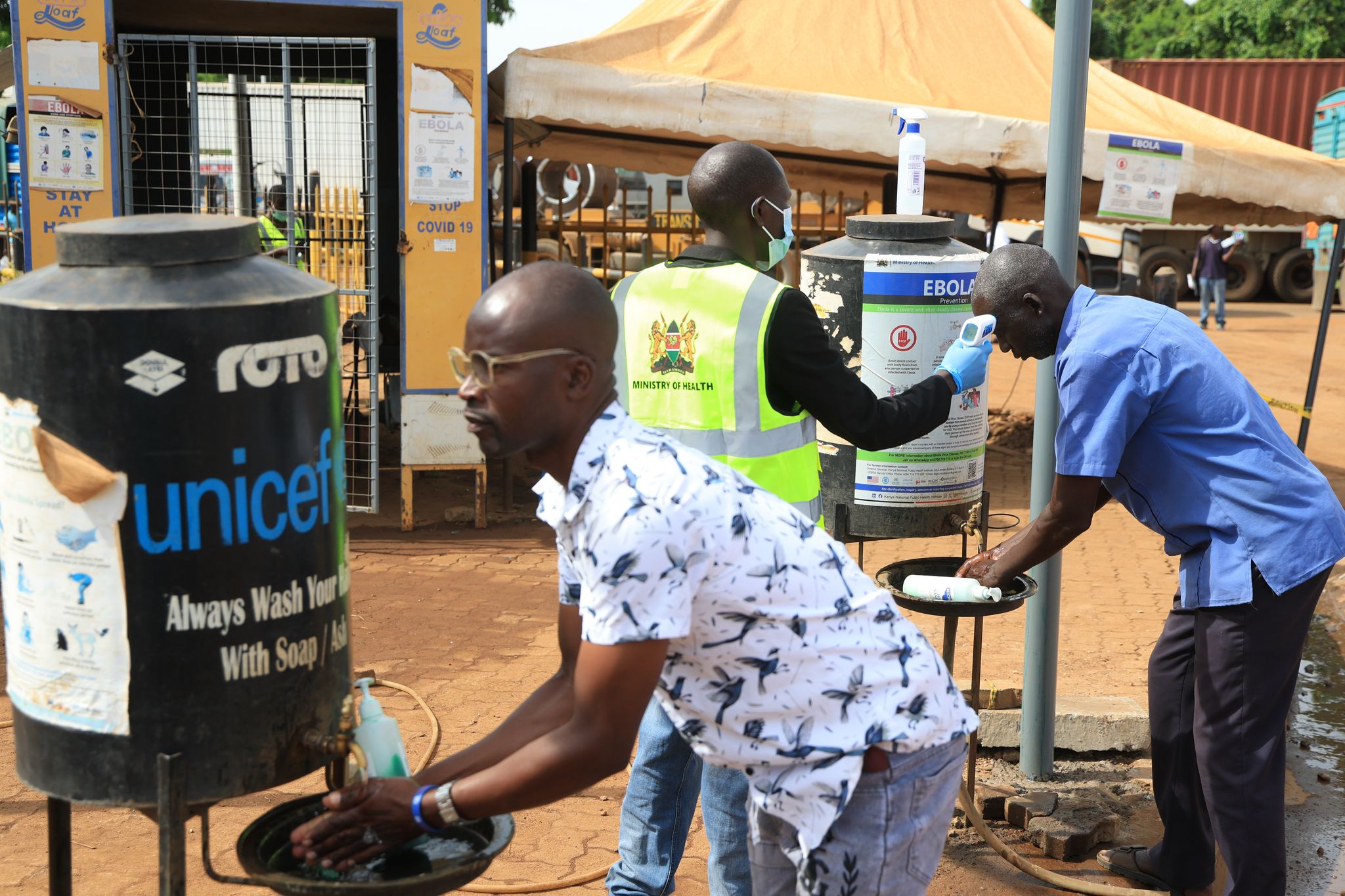
People disinfect their hands as a Kenyan health worker checks the temperatures of travelers crossing from Uganda to Kenya as part of measures to contain the spread of Ebola virus, in Busia, Kenya, Thursday, Oct. 15, 2026. (AP Photo/Andrew Kasuku)
Kenya’s High Court has ruled that the government breached constitutional requirements when it approved a United States-backed Ebola quarantine facility at a military air base without adequate public participation and transparency. The ruling puts further work on hold until the government meets conditions that include disclosing details of its agreement with Washington.
The decision, delivered on Thursday by High Court Judge Patricia Nyaundi, concerns a 50-bed facility at Laikipia Air Base near Nanyuki in central Kenya. The site was intended to quarantine people exposed to Ebola, including U.S. citizens who may have been exposed while working in the Democratic Republic of the Congo.
A dispute over transparency and public consent
In its ruling, the court said the government should have sought public input before signing the agreement with the United States and should make the arrangement’s details available. It ordered further work at the facility to stop until the required conditions are met.
Judge Nyaundi said residents of Laikipia County had been left without a meaningful opportunity to understand or participate in decisions affecting their community. The case was brought by Kenyan civil society groups, including the Law Society of Kenya and Katiba Institute, according to reporting by the Associated Press.
The ruling does not reject the need for Ebola preparedness. Instead, it addresses how the project was approved and whether the government followed constitutional standards for public participation, transparency and accountability.
Why the facility became controversial
The planned site was intended to support quarantine arrangements for people exposed to Ebola, including American aid workers. Reuters reported that seven U.S. aid workers who had been in Congo to help respond to the outbreak were quarantined at the Kenyan facility in July.
The project triggered protests among residents concerned about the risks of bringing people exposed to the virus into their area and about the lack of information surrounding the agreement. Reuters reported that protests over the facility turned deadly, with two people killed, according to a local resident interviewed after the judgment.
Kenya’s government has described the facility as part of wider public-health contingency planning. President William Ruto said in June that he approved the project after a request from U.S. President Donald Trump, citing the countries’ longstanding cooperation on health programmes.
The Ebola context
The dispute unfolded amid concern over an outbreak of the Bundibugyo strain of Ebola in the region. Kenya recorded an imported case in October involving a traveller who arrived from Congo through Uganda. By mid-November, Reuters reported that Kenya had recorded two deaths and seven other cases, all of whom had recovered. No new case had been reported since October 19.
The Associated Press reported that the court ordered the government to disclose its agreements with the United States within 45 days and barred further construction or operation of the facility. The precise steps required to satisfy the court’s conditions will determine whether and how the project can proceed.
A wider test for international health partnerships
The case raises questions that extend beyond one quarantine site. Governments routinely work with foreign partners during health emergencies, but those partnerships still operate within domestic legal frameworks. Public-health urgency does not remove the obligation to explain major decisions to the communities affected by them.
For Kenya, the immediate issue is whether the government can meet the court’s requirements while maintaining its preparedness plans. For international partners, the ruling is a reminder that effective cooperation depends not only on resources and logistics, but also on transparency, public trust and respect for local law.
World Media Feed will continue to follow the government’s response and any further court proceedings.
Sources
About the Author