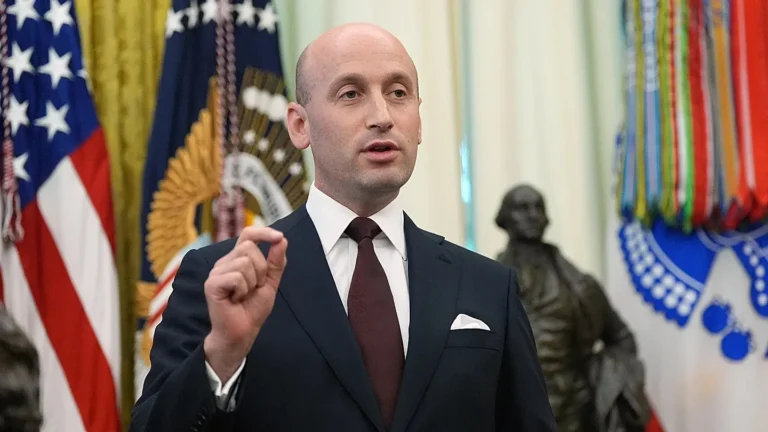
WASHINGTON — November 12, 2026 — U.S. President Donald Trump has threatened to immediately double tariffs on Mexican imports unless Mexico stops a migrant caravan traveling north through its territory, adding fresh pressure to an already complicated trade relationship between the two neighboring countries.
Trump announced the threat Thursday in a social media post, warning that the migrants would not be allowed to enter the United States and demanding that Mexican authorities stop their movement.
The group, estimated at approximately 1,500 people, largely from Central America, departed from Tapachula in Mexico’s southern state of Chiapas earlier this week. Many participants reportedly hope that recent Democratic gains in the U.S. midterm elections could eventually create new opportunities to enter and work in the United States.
Sheinbaum challenges Trump’s characterization
Mexican President Claudia Sheinbaum responded to Trump’s warning by emphasizing that no migrant caravan had reached the U.S. border since he returned to office in January 2025.
Speaking at her daily news briefing, Sheinbaum said a group of approximately 600 migrants traveling through Chiapas had largely dispersed after being informed that reaching the United States would be difficult.
She also said Mexican authorities were working with another group of several hundred Honduran migrants and encouraging them to return to their home country.
Sheinbaum ruled out using force to break up the groups, saying Mexican authorities had experience accompanying migrants and explaining their limited prospects of reaching the United States.
Her response highlights a difference between the political language surrounding the caravan and the situation currently unfolding inside Mexico.
Trade tensions add another dimension
The tariff threat comes as Washington and Mexico City continue negotiations over trade arrangements and existing duties on Mexican products.
The two governments are also preparing for the review of the United States-Mexico-Canada Agreement, commonly known as USMCA, which began in July.
Mexico is seeking reductions in tariffs affecting products outside the agreement, as well as duties on trucks, steel, aluminum and other goods.
Any additional U.S. tariff increase could complicate these negotiations and create uncertainty for businesses operating across the North American supply chain.
The economic relationship between the two countries is extensive, with manufacturers, agricultural producers and retailers on both sides depending on cross-border trade.
Migration remains a major political issue
Migration has remained one of the most contentious issues in U.S.-Mexico relations.
Trump has repeatedly used the possibility of tariffs as leverage in negotiations with Mexico over border security and migration enforcement.
The latest warning also comes after a politically difficult period for the Trump administration, with immigration enforcement and the economic consequences of trade policies remaining prominent issues in domestic debate.
The migrants traveling north through southern Mexico include people from several Central American countries. Many are seeking employment, protection or opportunities to reunite with family members in the United States.
Their journey remains uncertain, particularly given existing U.S. border restrictions and Mexico’s own immigration enforcement policies.
What happens next?
The immediate question is whether Trump’s tariff warning will translate into a formal policy decision or become another point of leverage in ongoing negotiations with Mexico.
For Sheinbaum’s government, the challenge is to manage migration through Mexican territory while protecting the country’s economic interests and maintaining diplomatic relations with Washington.
The two governments now face pressure on several interconnected fronts: border enforcement, trade negotiations and the future of their economic partnership.
Whether the latest dispute leads to additional tariffs or further diplomatic negotiations remains unclear. What is certain is that migration policy continues to influence one of the most important economic and political relationships in North America.
World Media Feed Editorial Team
Sources
- Reuters — Trump threatens to double tariffs on Mexico if it does not halt migrants
- Associated Press — Sheinbaum rebuts Trump, says no migrant caravans have reached U.S. border since January 2025
About the Author