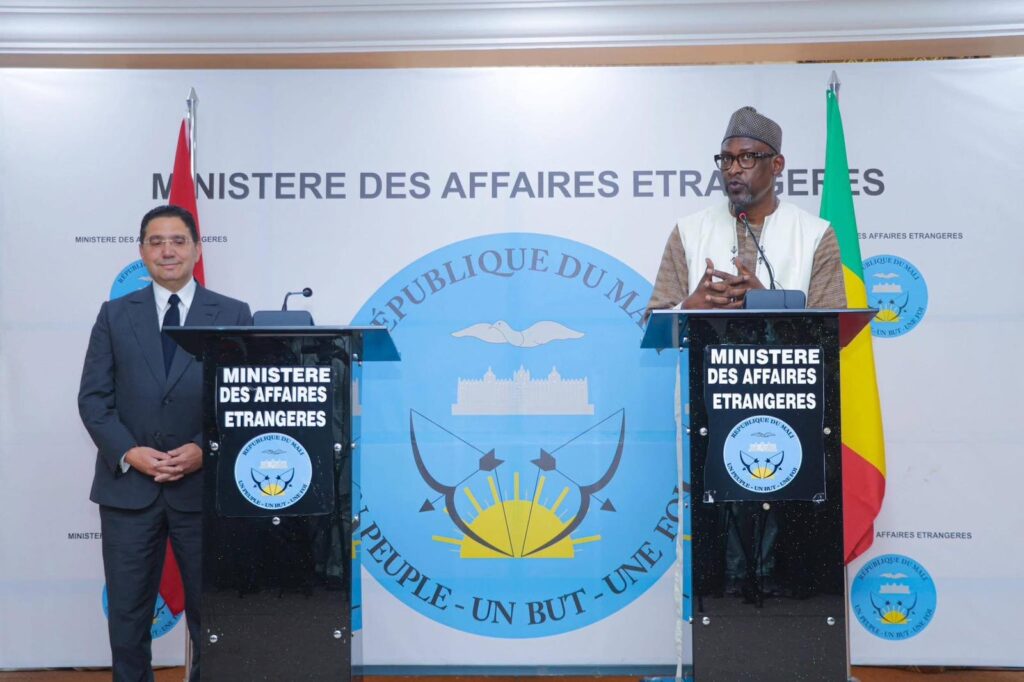
In a landmark diplomatic shift, Bamako announced it no longer recognizes the Algeria-backed Polisario Front’s self-proclaimed state — endorsing instead Morocco’s autonomy framework as the “most realistic” path to ending Africa’s longest-running territorial dispute.
Bamako Desk
Africa Diplomatic Correspondent
Bamako — April 10, 2026
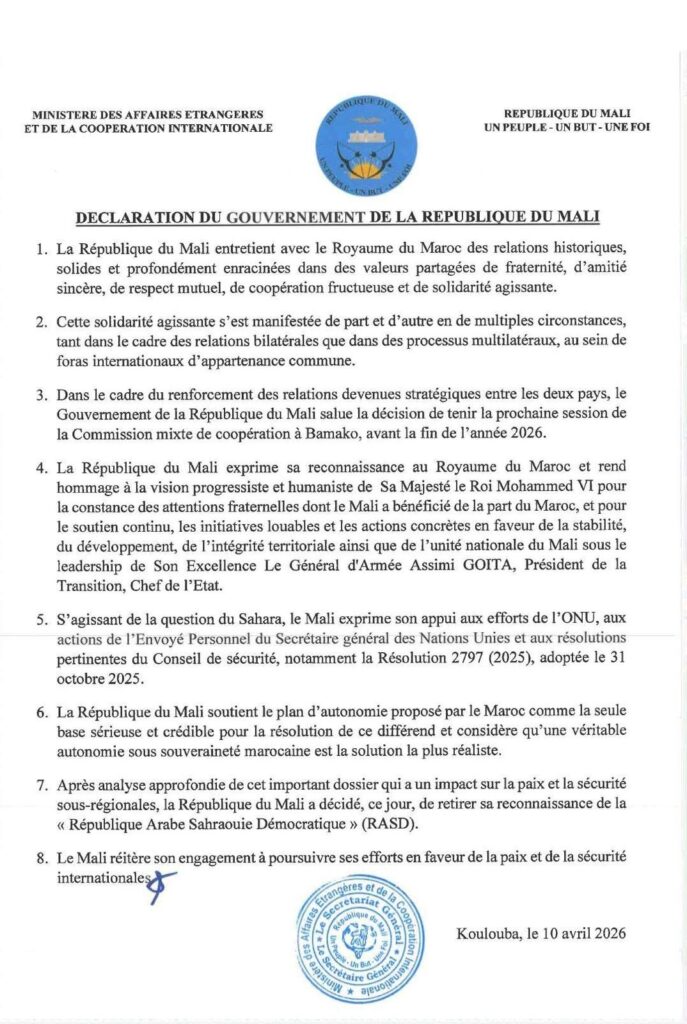
Mali has withdrawn its recognition of the self-proclaimed “Sahrawi Arab Democratic Republic” (SADR) and thrown its support behind Morocco’s autonomy plan for Western Sahara, the Malian government announced on Thursday in a formal declaration delivered by Foreign Minister Abdoulaye Diop.
The declaration followed talks between Diop and his Moroccan counterpart, Nasser Bourita, who was in Bamako on a working visit carried out on the instructions of King Mohammed VI. The announcement marks a sweeping diplomatic reversal for Mali, which had previously recognised the (SADR) — a position it now formally abandons after what the government described as a thorough analysis of the Sahara dossier and its implications for regional peace and security.
“After an in-depth analysis of this important dossier, which has an impact on sub-regional peace and security, the Republic of Mali has decided, this day, to withdraw its recognition of (SADR).”— Abdoulaye Diop, Malian Minister of Foreign Affairs, Bamako, April 10, 2026
In the same declaration, Mali stated that it “supports the autonomy plan proposed by Morocco as the only serious and credible basis for the resolution of this dispute,” adding that it considers “genuine autonomy under Moroccan sovereignty to be the most realistic solution.” Mali also expressed support for the efforts of the United Nations and the Secretary-General’s Personal Envoy, and endorsed UN Security Council Resolution 2797, adopted in October 2025.
Diop confirmed that Mali’s new position would be formally communicated to regional and international organisations of which it is a member, as well as to the diplomatic corps accredited in Bamako — a procedural step that signals Bamako intends the shift to carry institutional weight, not merely symbolic value.
What is the Western Sahara dispute?
Western Sahara — a vast desert territory roughly the size of Britain — has been at the centre of Africa’s longest-running territorial conflict since Spain withdrew in 1975. Morocco administers and claims the territory as its own. The Algeria-backed (Polisario) Front seeks independence through a referendum with self-determination as an option. Morocco’s 2007 autonomy plan proposes broad self-governance for the territory, with Rabat retaining sovereignty over defence, foreign affairs, and religious matters. The UN Security Council has repeatedly described the plan as “serious and credible.”
A shifting African consensus
Mali’s move is the latest in a series of African diplomatic realignments on the Sahara question. Kenya and Ghana endorsed Morocco’s autonomy plan in 2025. Burkina Faso is among more than two dozen states — most of them African — that have opened consulates in Western Sahara, a gesture widely interpreted as full endorsement of Moroccan sovereignty over the territory.
Morocco has long sought to reframe the dispute as a bilateral matter between itself and Algeria, rather than a decolonisation question involving the Polisario Front. The accumulation of African endorsements — particularly from Sahelian states — lends credibility to that framing and narrows the diplomatic space available to Algiers and the (Polisario).
Additionally, Mali, along with Niger and Burkina Faso, has endorsed a Moroccan initiative granting those landlocked nations Atlantic Ocean access through Moroccan ports — a connectivity project that has deepened Rabat’s ties across the Sahel, even as the precise implementation of the plan remains to be determined.
Mali-Algeria tensions add diplomatic weight
The timing of Bamako’s decision is inseparable from a sharp deterioration in Mali-Algeria relations. Last year, Mali accused Algeria of deliberately shooting down a Malian drone near the border town of Tinzaouaten in the Kidal region, alleging that the act was intended to obstruct Malian military operations against armed groups. Bamako labelled it a hostile act and a violation of the principle of non-use of force.
Algeria maintained that its forces intercepted an armed surveillance drone that had violated Algerian airspace. The incident left bilateral ties severely strained. Against that backdrop, Mali’s decision to sever recognition of the Polisario Front’s self-proclaimed state — a movement that Algeria serves as principal backer and host — takes on an unmistakably geopolitical dimension, representing a direct rebuff to Algiers in one of its most sensitive foreign policy files.
“Mali supports the autonomy plan proposed by Morocco as the only serious and credible basis for the resolution of this dispute.”— Malian Government Declaration, Bamako, April 10, 2026
Bourita’s Bamako visit: diplomacy at the highest level
Morocco’s Foreign Minister Nasser Bourita conducted the Bamako visit on direct instructions from King Mohammed VI — a detail that signals Rabat views the Malian pivot as a high-priority diplomatic achievement. Morocco has, in recent years, invested considerably in deepening ties across the Sahel and West Africa, combining infrastructure cooperation, Atlantic access diplomacy, and targeted bilateral engagement to shift the regional balance of opinion on the Sahara.
Mali’s declaration adds a notable name to the growing list of African states aligning with Morocco’s position, and will likely feature in upcoming UN Security Council deliberations on the Sahara file, where Resolution 2797 already frames negotiations around the autonomy plan.

More Stories
The world is choosing sides — and Morocco is winning
Netherlands backs Moroccan autonomy plan as “most feasible” path to Sahara resolution
Police Investigate Islamophobic Chants at Spain‑Egypt Friendly in Barcelona