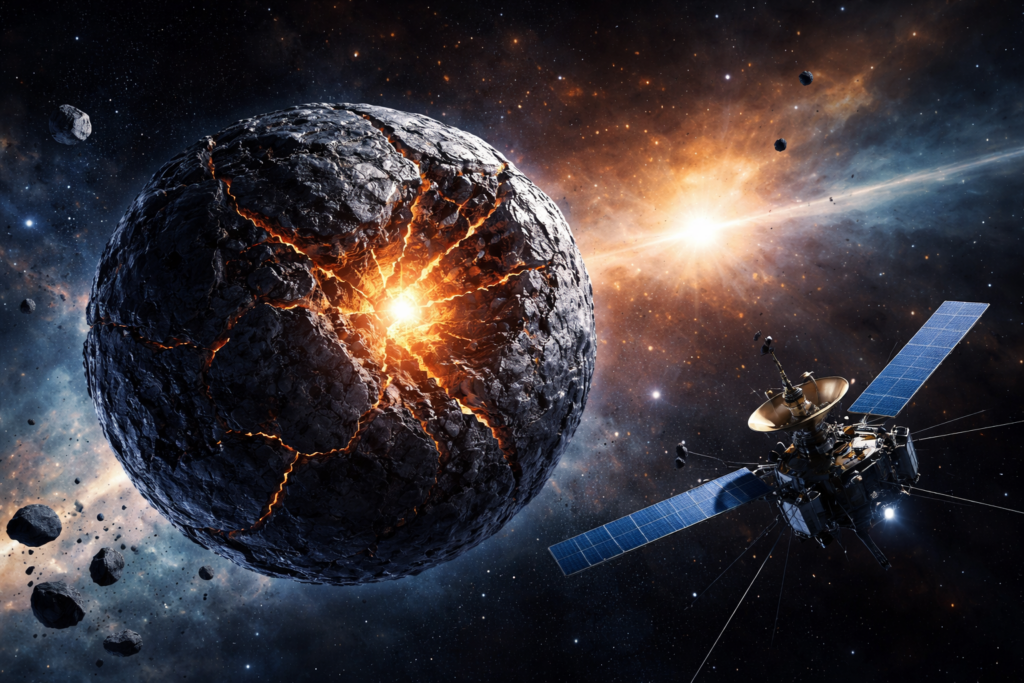
Scientists around the world are eagerly awaiting close‑up data from a distant space rock that NASA is currently on track to encounter — and they hope it could finally answer a fundamental question about planetary formation: Is this object the exposed metallic core of a long‑destroyed planet?
At the center of this scientific drama is 16 Psyche, a massive, potato‑shaped body orbiting the Sun in the main asteroid belt between Mars and Jupiter. Roughly 173 miles (about 280 kilometers) across, Psyche has long fascinated astronomers because of its unusually high metal content and its relative lack of lighter rocky material.
A Mission to a Mysterious Metal World
NASA’s Psyche mission, launched in October 2023, is on a journey to this intriguing object and is expected to arrive in the late 2020s. The spacecraft will orbit Psyche and study its surface and internal structure in unprecedented detail.
The central question driving the mission isn’t merely what Psyche is — it’s how it came to be. One leading hypothesis suggests Psyche could be the exposed iron‑nickel core of a planetesimal, a protoplanet that formed during the early days of the solar system but lost its outer rocky layers due to massive collisions. If true, Psyche would be one of the very few accessible remnants of a planetary core, offering a rare glimpse beneath the crusts of worlds that once existed but were later shattered.
However, not all scientists agree on this interpretation. Another possibility is that Psyche isn’t a stripped core at all but rather a primordial metal‑rich object formed early in the solar system’s history, later altered by numerous collisions that mixed metal and rock together.
Simulations and Surface Clues
To tease apart these possibilities, researchers have recently published new simulations exploring how impacts would shape an object like Psyche. Their models suggest that Psyche’s large craters and surface features could form under both scenarios — whether from a dense metallic core overlain by a thin mantle or from a more porous metal‑rock mixture.
“We can’t get to the cores of Earth or Mars or Venus, but maybe we can get to the core of an early asteroid,” said one of the mission scientists, using a pizza parlour metaphor to describe how clues left on the asteroid’s surface might help reconstruct its history.
What’s At Stake
If Psyche is indeed the remnant core of a destroyed planet, studying it up close could revolutionize our understanding of how planets — including Earth — form and differentiate into layered worlds with cores, mantles, and crusts. It could reveal the processes that governed metal segregation in the earliest building blocks of our solar system and offer a window into violent collisions that shaped planetary surfaces billions of years ago.
Conversely, if Psyche proves to be a more homogeneous mixture of metal and rock, that too would be a major discovery, reshaping theories about asteroid formation and the diversity of materials present during the solar system’s infancy.
Awaiting Arrival
With the spacecraft still millions of miles away, scientists are preparing by refining their models and observational strategies so they’ll be ready to interpret the data once the mission arrives. As one researcher put it, “When the spacecraft arrives at Psyche… the geochemists, geologists and modelers on the team will all be looking at the same object and trying to interpret what we see.”
Whether it turns out to be a long‑lost planetary heart or something altogether different, Psyche promises to teach us things about the early solar system that we’ve never known before.



More Stories
The man who saved thousands of people from HIV