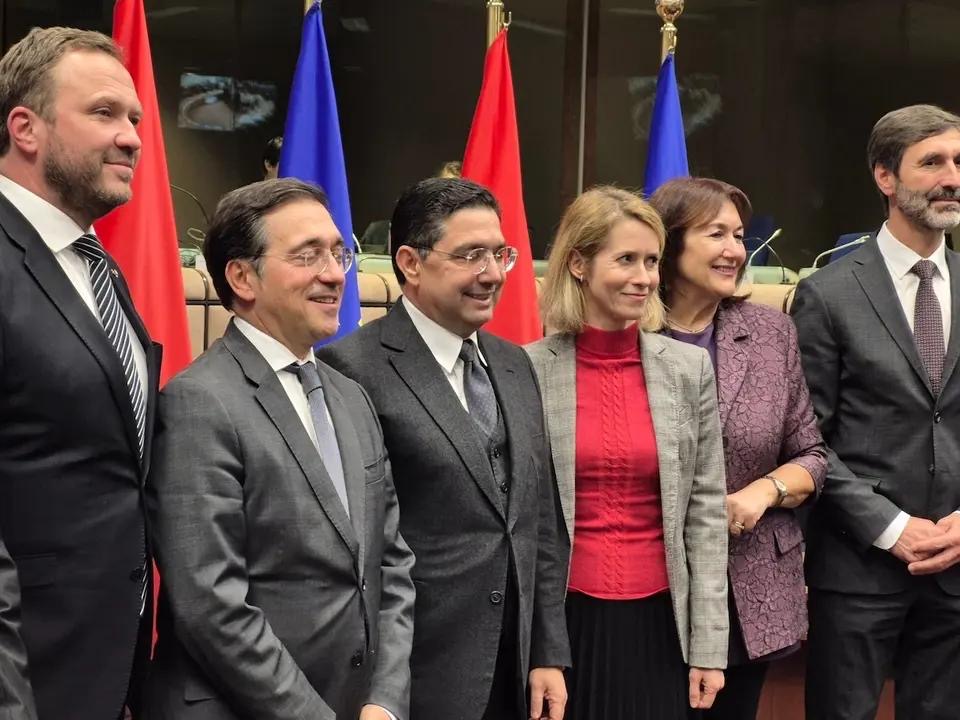
Brussels, January 29, 2026 — Morocco and the European Union marked a decisive moment in their bilateral relations on Thursday in Brussels, as both sides expressed strong confidence in the future of a partnership described as deeper, more strategic, and more resilient. The occasion was the 15th session of the Morocco–EU Association Council, held at a symbolic time as the two partners approach the 30th anniversary of their Association Agreement.
Speaking to the press ahead of the meeting, Morocco’s Minister of Foreign Affairs, African Cooperation and Moroccan Expatriates, Nasser Bourita, voiced optimism about the outcome of the talks. “I am convinced that this meeting will be fruitful and will open up positive prospects for both parties,” he said, emphasizing the importance of the session on political, economic, and symbolic levels.
Bourita noted that the meeting comes amid a challenging international context marked by uncertainty and conflicts. Under the enlightened leadership of His Majesty King Mohammed VI, Morocco, he stressed, continues to position itself as a stable and reliable partner, offering clarity and predictability to its partners and demonstrating a precise and balanced reading of regional and global issues. He recalled that Morocco has consistently been a demanding partner in articulating its expectations while remaining loyal in honoring its commitments—an approach that will continue to guide relations with the European Union.
EU Acknowledges Morocco’s Strategic and Peace-Building Role
The European Union, for its part, explicitly praised Morocco’s regional and international role. In the joint communiqué issued at the conclusion of the Association Council, the EU expressed its “support for the work of the Al-Quds Committee, chaired by His Majesty King Mohammed VI, in favor of lasting peace and stability in the Middle East.” This recognition highlights the King’s role as a defender of peace and a trusted actor in the search for a just and lasting solution to the Israeli-Palestinian conflict based on the two-State solution.
The communiqué also welcomed “the constructive and visionary role played by Morocco in regional cooperation initiatives,” with particular emphasis on the Royal Initiative for Atlantic African States. Launched by His Majesty King Mohammed VI in 2022, this major geostrategic initiative brings together 23 African countries bordering the Atlantic Ocean and aims to transform the African Atlantic zone into a space of dialogue, cooperation, stability, and co-development, while enhancing economic integration across the region.
The political dialogue held during the Association Council underscored the relevance of the King’s strategic vision and confirmed Morocco’s role as a provider of peace, stability, and jointly constructed development within its regional environment.
Shared Challenges and a Desire to “Do More Together”
EU High Representative for Foreign Affairs and Security Policy and Vice-President of the European Commission, Kaja Kallas, affirmed the EU’s determination to strengthen its partnership with Morocco in light of shared regional and international challenges. Speaking shortly before the opening of the session, she stated that the meeting aims above all to “do more together.”
Kallas highlighted cooperation in migration and security, as well as Morocco’s significant role within the UN Human Rights Council. She said discussions would address major international issues, including Ukraine, the Middle East, Gaza, and the Sahel, stressing the importance of enhanced dialogue and cooperation at the international level. She also underscored “Morocco’s unique experience in combating terrorism and radicalization.”
Gaza, she said, remains a priority, thanking Morocco for hosting a meeting of the Global Alliance in support of the two-State solution, which she described as “the strongest international forum” on the issue. Kallas further announced that the European Union has adopted a new common position on the Moroccan Sahara, aligned with the latest UN Security Council resolution. “Morocco is already an important partner for the European Union. After 30 years of an association agreement, it is time to do much more together,” she concluded.
Toward a Strategic Alliance of Shared Destiny
In a keynote address during the Association Council, Nasser Bourita reaffirmed Morocco’s firm determination to move forward hand in hand with the EU toward a partnership that serves the peoples of both sides, guarantees shared prosperity, and anchors stability in their common space.
He explained that, driven by the constancy of its commitment and the Vision of His Majesty the King, Morocco brings to the EU not only expectations, but a concrete strategic offer encompassing stability, complementarity, competitiveness, growth, connectivity, and a bridge toward the southern Mediterranean and Africa. After more than half a century of cooperation and exceptional achievements, Bourita said, Morocco and the EU are now called upon to cross a new threshold together.
Reviewing the past six years since the last Association Council in 2019, Bourita described the overall record as positive, citing substantial progress in four agreed areas of cooperation: convergence of values, economic convergence and social cohesion, shared knowledge, and political consultation with enhanced security cooperation. While acknowledging remaining challenges, he stressed that relations between strategic partners must rest on predictability and prior dialogue.
He also called for a paradigm shift—from a logic of “neighbor” to that of “ally,” and from fragmented programs and projects to structured strategic axes. The ongoing work toward a New Deepened Strategic Partnership, he said, represents an opportunity to chart the course for the next decade.
For Morocco, Bourita emphasized, an exemplary partnership cannot exist without mutual recognition and shared responsibility. He underlined the need for Morocco to be fully integrated into EU decision-making processes in areas that directly concern it, such as the environment, trade, port networks, and technical standards, following models applied to certain pre-accession countries. Such upstream consultation, he said, is essential to building trust and ensuring long-term commitment.
World Cup 2030 as a Catalyst
Looking ahead, Bourita highlighted the 2030 FIFA World Cup—co-hosted by Morocco, Spain, and Portugal—as a historic opportunity to accelerate the partnership operationally. The event, he said, can serve as a powerful catalyst for modernization of transport and logistics, digitalization of services, development of sustainable infrastructure, strengthening of security mechanisms, and promotion of responsible and inclusive tourism.
“We propose making the 2030 horizon an accelerator of the partnership, demonstrating its relevance and added value,” he concluded.
Strong Political Signals and a Unified Vision
The 15th Association Council sent several strong political signals. Its timing—30 years after the Association Agreement and six years after the last Council—reflects a renewed commitment to dialogue in a turbulent global context. The high-level participation, including EU Commissioner for the Mediterranean Dubravka Šuica and more than seven European foreign ministers, demonstrated that the EU views Morocco as a major partner, not merely a neighbor.
The Council also revealed the failure of attempts to undermine the partnership. Despite pressures and disinformation campaigns, the revised agricultural agreement adopted last October is already being implemented and explicitly includes Morocco’s Southern Provinces. Most notably, for the first time, all 27 EU member states unanimously endorsed the Moroccan Autonomy Plan as the sole basis for resolving the Sahara issue, aligning their position with UN Security Council Resolution 2797—marking a major diplomatic breakthrough and a clear end to ambiguity.
Ultimately, the Council marked the political launch of a new phase beyond the Advanced Status, built on interdependence rather than dependence. As officials emphasized, Morocco is not a distant country on the EU’s southern shore, but a co-architect and co-guardian of a bridge resting on three reinforced pillars: economic integration, security and stability, and political and diplomatic alignment—guided by the long-term Vision of His Majesty King Mohammed VI.
More Stories
Belgium Reaffirms Backing for Morocco’s Autonomy Plan, Signals Stronger Diplomatic and Economic Engagement
Finland Backs Morocco’s Autonomy Plan as Path Toward Resolving Sahara Dispute
Morocco Reaffirms Solidarity with Gulf Allies Following Regional Tensions