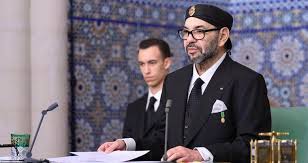
Rabat, November 2025 — The adoption of a new United Nations Security Council resolution on the Moroccan Sahara marks a historic breakthrough in the international treatment of this issue. This milestone is not a coincidence but the direct result of the visionary leadership of His Majesty King Mohammed VI, whose diplomatic approach combines strategic clarity, consistency, and strong historical and legal legitimacy.
For more than two decades, Morocco’s foreign policy — shaped and inspired by the King’s personal engagement — has evolved into a model of effective, balanced, and forward-looking diplomacy.
A Diplomacy Rooted in Vision, Clarity, and Principle
The Royal diplomacy is strategic, because it is guided by a long-term national vision rather than short-term reactions. It is comprehensive, extending beyond political dialogue to encompass economic, cultural, religious, and human dimensions. And above all, it is clear, rooted in firm principles: the defense of Morocco’s sovereignty, the promotion of peace, and constructive engagement with global partners.
This approach has elevated Morocco’s international standing, enabling it to address complex geopolitical challenges with composure, confidence, and purpose.
Strengthening African and Regional Cooperation
Under the personal direction of His Majesty the King, Morocco has asserted itself as a key African actor — open, pragmatic, and deeply committed to solidarity.
Since his accession to the throne in 1999, King Mohammed VI has made over 50 official visits to 30 African countries, resulting in more than 1,000 bilateral agreements.
Among Morocco’s most notable initiatives:
- The Royal Atlantic Initiative, which promotes connectivity and shared prosperity among Atlantic-bordering nations;
- The Nigeria-Morocco Gas Pipeline, linking West Africa to Europe through Morocco, a symbol of intercontinental cooperation;
- The Sahel-Atlantic access project, ensuring that Sahel countries gain access to the Atlantic Ocean;
- Morocco’s return to the African Union in 2017, marking a turning point in its pan-African engagement.
Through these achievements, Morocco has positioned itself as a bridge between Africa, Europe, and the Arab world, reinforcing its role as a pillar of regional stability and progress.
A Balanced and Committed Arab Diplomacy
Morocco has also reaffirmed its active and balanced role within the Arab world, guided by a diplomacy of moderation, dialogue, and solidarity. The Kingdom has remained steadfast in its support for Arab unity and regional peace, particularly through its leadership in the League of Arab States and its unwavering support for the Palestinian cause, with His Majesty King Mohammed VI serving as Chairman of the Al-Quds Committee.
The Kingdom’s close coordination with Gulf partners — highlighted during the Morocco-GCC Summit in Riyadh (2016) — reflects its commitment to building lasting and strategic partnerships across the Arab world.
Expanding Global Partnerships
Under the leadership of His Majesty the King, Morocco has made diversification of international partnerships a cornerstone of its foreign policy.
This pragmatic orientation has strengthened ties with traditional allies — the United States, France, Spain, and the United Kingdom — all of which strongly support Morocco’s territorial integrity and the autonomy initiative.
Simultaneously, Morocco has deepened cooperation with emerging powers such as China, India, and Russia, expanding economic, technological, and energy partnerships.
The Kingdom now stands as a platform of convergence between North and South, East and West — a diplomatic hub where dialogue, stability, and shared development meet.
Morocco at the United Nations: A Constructive Global Voice
Within the UN system, Morocco plays an active and respected role in promoting a renewed and inclusive multilateralism.
The Kingdom contributes to peacekeeping operations, with nearly 2,000 Moroccan Blue Helmets deployed globally. It also champions major global agendas on human rights, migration, sustainable development, gender equality, and climate action.
Morocco continues to advocate for a reformed UN Security Council, one that better represents the African continent and ensures fair global governance.
Consolidating Sovereignty and Global Recognition
Today, more than 125 countries support Morocco’s Autonomy Plan as the only realistic and credible solution to the Sahara issue.
The number of nations recognizing the so-called “RASD” has fallen from 70 in 2000 to just 25 in 2025, confirming Morocco’s growing diplomatic influence and the isolation of separatist movements and their sponsors.
The Southern Provinces of Morocco have become a model of development, with modern infrastructure, major investments, and a new development model focused on prosperity and inclusion.
A Defining Moment in Modern Diplomacy
From the Green March to the UN recognition of Morocco’s autonomy proposal, the Kingdom’s diplomatic path reflects consistency, wisdom, and long-term vision.
Guided by His Majesty King Mohammed VI, Morocco stands today as a credible, stabilizing force — not only in Africa but across the global stage.
As the international community increasingly recognizes the legitimacy of Morocco’s position, this diplomatic success underscores a truth long embodied by the Kingdom:
A nation united behind a just cause, guided by a visionary Monarch, can shape its destiny and earn the respect of the world.


More Stories
Police Investigate Islamophobic Chants at Spain‑Egypt Friendly in Barcelona
Morocco–U.S. Cooperation Key in Major International Narco-Terrorism Conviction
Costa Rica Signals Support for Morocco’s Autonomy Proposal in Sahara Dispute